The AI Colleague Era: Preparing for Work’s Biggest Shift
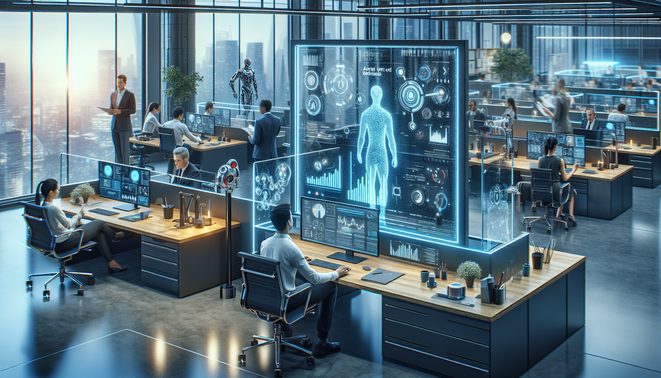
Imagine arriving at work to find that your new colleague never sleeps, processes information thousands of times faster than you, and can juggle a dozen complex projects simultaneously without breaking a sweat. This isn’t science fiction—it’s the reality unfolding in enterprises worldwide as agentic AI systems move from pilot programs to production. We’re witnessing something profound: artificial intelligence evolving from a tool we use into an autonomous workforce that acts, decides, and delivers independently. The numbers tell a striking story—between now and 2030, roughly 200 million jobs will transform so fundamentally that workers will need to rebuild their professional identities almost from scratch. This isn’t just another wave of automation. It’s a complete reimagining of what work means, who does it, and what makes humans irreplaceable in an age of intelligent machines.
The Transformation Underway
Traditional AI responded to our questions and offered recommendations. Agentic AI takes the next step—it plans, executes, learns, and operates with minimal human oversight. These systems don’t just analyze your supply chain; they autonomously reorder inventory, negotiate with suppliers, and reroute shipments when disruptions occur. They don’t just draft customer service responses; they resolve issues end-to-end, escalating only when situations require human judgment or empathy.
The enterprise infrastructure emerging to support these capabilities—platforms like Cisco’s Secure AI Factory—provides the secure, scalable foundation that transforms AI from experimental to operational. Early adopters are already reporting productivity gains of 30 to 40 percent in pilot programs, a magnitude of improvement that fundamentally alters competitive dynamics.
Financial services firms are deploying AI agents that monitor regulatory compliance around the clock, flagging potential violations before they occur. Healthcare systems use autonomous agents to optimize scheduling and resource allocation, freeing clinical staff to focus on patient care rather than administrative coordination. In software development, AI agents now write, test, and debug code while human developers shift toward architectural design and strategic problem-solving. Manufacturing companies have handed supply chain management to AI systems that forecast demand, manage inventory, and adapt to disruptions in real-time.
The pattern is consistent across sectors: routine cognitive work—the kind that follows established procedures and rules—is rapidly moving to artificial intelligence. One analysis suggests these systems could automate activities that currently consume 60 to 70 percent of employees’ time. We’re not talking about automating tasks within jobs; we’re talking about automating entire roles.
The Job Market Reconfiguration
The employment mathematics of this transition are sobering but not catastrophic. Projections suggest that between 75 and 83 million jobs globally will be displaced by 2030, while 60 to 69 million new positions will emerge—a net loss of 8 to 15 million jobs. But these aggregate numbers mask the true disruption: hundreds of millions of workers will find their current roles fundamentally transformed, requiring new skills, new mindsets, and new professional identities.
Customer service illustrates this reconfiguration clearly. Tier-one support roles—handling routine questions, processing simple requests, following standard procedures—face 70 to 80 percent displacement risk. AI agents handle these interactions faster, more consistently, and at vastly lower cost. But the humans who remain aren’t doing the same job with slightly different tools. They’re becoming complex issue specialists and customer success advocates, handling only escalated situations that require nuanced judgment, managing high-value client relationships, and solving problems that fall outside established protocols. The work is more demanding, requires deeper expertise, and commands higher compensation—but there are far fewer positions.
This pattern repeats across the occupational landscape. Basic bookkeepers transition to financial strategy advisors or exit the profession entirely. Routine paralegals must specialize in complex legal research or upskill dramatically. Administrative assistants handling scheduling and correspondence find their roles automated, while those who evolve focus on executive support requiring discretion, judgment, and relationship management.
Yet displacement tells only half the story. Entirely new occupational categories are emerging. AI Agent Orchestrators coordinate multiple AI systems working across different business domains, ensuring they align with organizational objectives—a role projected to create 500,000 to 800,000 positions globally within six years. AI Ethics and Governance Specialists ensure responsible deployment, monitoring for bias and developing organizational policies around artificial intelligence. Human-AI Collaboration Designers optimize the workflows where humans and machines intersect, creating interfaces and handoff protocols that maximize the strengths of both.
As one Stanford researcher noted, “The question isn’t whether AI will take your job”—it’s “whether you’ll be the person working with AI or replaced by someone who is.” The dividing line increasingly separates those who can leverage AI to amplify their capabilities from those who compete against it.
Skills for the AI Era
The skills landscape is shifting beneath our feet, with technical proficiency and human capabilities both becoming more valuable—but in different ways. AI literacy is evolving from specialized knowledge to fundamental requirement, comparable to computer literacy in the 1990s. This doesn’t mean everyone needs to build AI systems, but professionals across functions must understand how these agents work, their limitations, when to trust their outputs, and when to intervene.
Prompt engineering—the ability to effectively direct AI systems through clear, contextual instructions—is becoming a universal workplace skill. Workers who can articulate problems precisely, specify constraints accurately, and iterate on AI-generated outputs will operate at a different productivity level than those who cannot. Data interpretation matters more than ever; AI can generate insights at scale, but humans must separate signal from noise, identify meaningful patterns, and ask the right questions.
Yet purely technical skills tell an incomplete story. The capabilities that remain distinctly human are commanding a growing premium. Complex problem-solving—tackling novel, ambiguous challenges without established procedures—remains firmly in human territory. Emotional intelligence and empathy become more valuable as AI handles routine interactions, leaving humans to build trust, navigate sensitive situations, and manage the human dimensions of business. Creative and strategic thinking—combining insights from disparate domains, generating novel approaches, seeing possibilities rather than just optimizing what exists—differentiates human contribution from AI execution.
Perhaps most critical is learning agility: the capacity to continuously acquire new skills, adapt to changing tools and processes, and maintain effectiveness amid ongoing transformation. Workers may need to pivot skills three or four times across their careers. The ability to learn—to remain intellectually curious and adaptable—becomes more important than any specific knowledge that may become obsolete.
Educational pathways must adapt accordingly. For the current workforce, continuous micro-credentialing offers focused, stackable training that builds over time without requiring workers to step away from employment. Apprenticeship models that pair experienced workers with AI systems provide hands-on learning. Cross-functional rotations build broader perspective and reduce over-specialization risk in a fluid environment.
Educational institutions face their own adaptation challenge. Integrating AI literacy into K-12 curriculum prepares coming generations for an AI-infused workplace. Universities must balance technical training with the critical thinking, communication, and ethical reasoning that become more valuable as routine cognitive work migrates to machines. The emphasis shifts from knowledge transfer to developing judgment, creativity, and the capacity for continuous learning.
The Path Forward
We stand at an inflection point that will define work for decades to come. The transformation underway is neither utopian nor dystopian—it’s complex, uneven, and still malleable based on choices we make collectively and individually.
For workers, the imperative is clear: develop AI literacy now, cultivate distinctly human skills that complement rather than compete with artificial intelligence, and embrace continuous learning as a permanent professional stance. Seek opportunities to work alongside AI systems and understand how they enhance your capabilities.
For employers, the responsibility extends beyond deployment to transition management. Companies that transparently communicate AI implementation plans, involve employees in the process, and invest seriously in reskilling see better outcomes and stronger retention. The focus should be augmentation before automation—enhancing human capabilities before replacing them—with genuine commitment to workforce development rather than treating it as a checkbox exercise.
For policymakers and educational institutions, the challenge is matching the pace of technological change with workforce preparation. Current training budgets and government programs lag years behind the technology curve, risking a generation of workers unable to transition successfully. We need massive investment in accessible reskilling infrastructure.
The future of work won’t be humans versus machines—it will be humans who effectively collaborate with AI versus those who don’t. The question facing each of us is simple and urgent: Which side of that divide will you be on, and what are you doing today to ensure you’re ready for tomorrow?