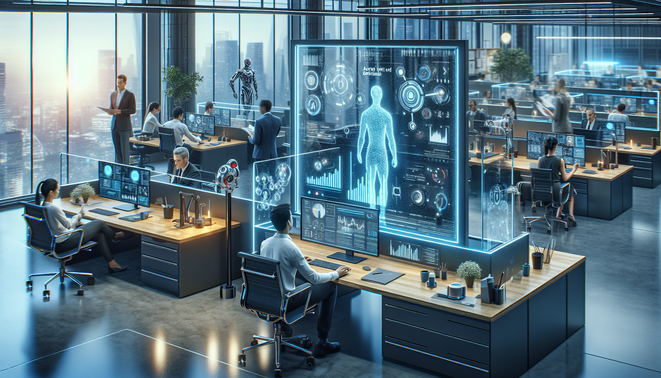
Imagine walking into your office in 2026 and discovering that your new colleague never sleeps, processes information at lightning speed, and can juggle dozens of tasks simultaneously. This isn’t science fiction—it’s the reality of agentic AI systems now entering enterprise environments. A recent Gartner survey reveals that 65% of enterprises plan to deploy autonomous AI agents by year’s end, fundamentally altering how work gets done.
We’re witnessing not just another wave of automation, but something more profound: a complete reimagining of the workplace itself. The question is no longer whether AI will transform jobs, but rather how we’ll navigate the transformation already underway. The answer matters deeply—for your career, your organization, and the 12 million workers who may need to change occupations by 2030 in developed economies alone.
Beyond the Hype: What’s Actually Changing
The enterprise AI landscape in 2026 bears little resemblance to the chatbot experiments of just a few years ago. Today’s systems combine multiple breakthrough capabilities that amplify their workplace impact. Agentic AI can now plan multi-step projects, learn from outcomes, and execute complex tasks with minimal human oversight. Meanwhile, multimodal AI processes text, images, video, and audio simultaneously, understanding context in ways that feel almost intuitive.
Perhaps most significantly, small language models are democratizing AI access. These efficient systems run on local devices at one-tenth the cost of cloud-based alternatives, making sophisticated AI tools available to organizations of all sizes. In manufacturing plants, they’re revolutionizing quality control. In hospitals, they’re streamlining administrative workflows while maintaining patient privacy.
The financial services sector exemplifies this transformation. Major banks now deploy AI agents that analyze market patterns, detect fraud, and provide preliminary investment guidance—tasks that previously required armies of analysts. One global investment firm reported that AI systems now handle 75% of routine client inquiries, allowing human advisors to focus exclusively on complex financial planning and relationship management.
Customer service has undergone an even more dramatic shift. AI agents don’t just answer questions anymore; they resolve issues end-to-end, escalating to humans only when emotional intelligence or creative problem-solving becomes essential. The numbers tell the story: organizations report that autonomous systems now handle 70-80% of routine customer interactions.
The Jobs Equation: Creation, Transformation, and Displacement
The employment impact of advanced AI defies simple narratives. Yes, certain roles are disappearing—data entry positions, basic bookkeeping functions, and template-based content creation are facing severe headwinds. Research suggests that 30% of work activities could be automated by AI by 2030, a timeline accelerated by five years from previous projections.
But the full picture is more nuanced. As MIT economist Erik Brynjolfsson observes, “Technology doesn’t determine outcomes—choices do.” The critical question isn’t whether AI can perform a task, but how organizations choose to deploy these capabilities.
Consider software development, where junior programmers initially seemed most vulnerable to AI code generation tools. Instead, we’re seeing a bifurcation. Entry-level roles focused on routine coding are indeed contracting, with studies indicating that 40% of such tasks are now automatable. However, demand for senior engineers has actually intensified—they’re needed to architect systems, supervise AI code generators, and solve complex technical challenges that remain beyond machine capability.
Entirely new job categories are emerging at remarkable speed. AI Agent Designers orchestrate workflows for autonomous systems, commanding salaries between $120,000 and $200,000. Prompt Engineers—specialists in communicating effectively with AI systems—earn $90,000 to $150,000. AI Ethics Officers ensure responsible deployment, while Human-AI Collaboration Specialists optimize team performance in hybrid environments.
The transformation of existing roles may ultimately matter more than net job creation or destruction. Graphic designers aren’t being replaced wholesale; they’re becoming AI art directors who curate and refine machine-generated options. Marketing managers increasingly focus on strategy and creative oversight rather than campaign execution. Accountants are shifting from data processing to strategic advisory services.
A pattern emerges across industries: professionals are moving from “doing the work” to “supervising AI doing the work” while adding high-value human judgment. As Andrew Ng notes, “For every job displaced, we’re seeing 2-3 new roles created.” But there’s a catch—these new roles demand different skills, and the transition isn’t automatic.
The New Skills Currency
What makes a worker valuable in an AI-augmented workplace? The answer combines surprising elements of both technical knowledge and distinctly human capabilities.
On the technical side, AI literacy has become table stakes. Every professional now needs baseline understanding of how AI systems work, their capabilities, and crucially, their limitations. Prompt engineering—the art of effectively instructing AI systems—is evolving from niche specialty to core competency. Even workers who never write code benefit from understanding data quality, algorithmic bias, and model evaluation fundamentals.
Yet the skills seeing the steepest value appreciation are those AI cannot easily replicate. Critical thinking matters more than ever because someone must evaluate AI outputs and make final judgment calls. Emotional intelligence—empathy, relationship building, reading subtle social cues—remains stubbornly human. Creative problem-solving that goes beyond pattern recognition represents a lasting competitive advantage.
UC Berkeley researcher Stuart Russell captures this shift perfectly: “The most important skill for the future isn’t technical—it’s the ability to ask good questions.” AI increasingly handles the answers, but determining what to ask, what matters, and what we’re optimizing for remains deeply human territory.
The most valuable professionals will master hybrid skills that bridge technical and human domains. Data storytelling—interpreting AI insights for human decision-makers—combines analytical and communication capabilities. AI-augmented design thinking merges tool proficiency with creative vision. Change management expertise becomes essential as organizations navigate cultural transformation.
Educational pathways are rapidly evolving to meet these needs. Major universities now integrate AI literacy across curricula, not just in technical programs. Bootcamps offering 12-16 week intensive training in AI-adjacent skills have proliferated. Seventy-five percent of large enterprises have launched internal AI academies, with reskilling budgets increasing 40% year-over-year.
The uncomfortable truth, however, is that access to quality AI education remains uneven. Workers with existing advantages—higher education, financial resources, flexible schedules—can most easily acquire new skills. Those already vulnerable risk being left further behind, potentially widening economic inequality unless governments and employers make massive investments in accessible retraining programs.
Navigating the Transition
The AI transformation of work presents both extraordinary opportunity and genuine risk. The outcome depends largely on choices we make today—as individuals, organizations, and societies.
For individual workers, the imperative is clear: invest in continuous learning. The half-life of skills is shrinking; what you know today may be obsolete in five years. Prioritize developing skills that complement rather than compete with AI. Seek opportunities to work alongside AI systems and learn their strengths and weaknesses firsthand. Build a professional network that spans technical and domain expertise.
Organizations bear responsibility for managing this transition humanely. The companies thriving in 2026 didn’t simply deploy AI and hope for the best—they invested heavily in reskilling existing employees, redesigned workflows around human-AI collaboration, and maintained focus on augmentation over replacement. They recognized that institutional knowledge and cultural cohesion matter, and that wholesale workforce turnover destroys both.
Policymakers face perhaps the greatest challenge. The market alone won’t solve the transition’s equity problems. Government-funded retraining programs, updated social safety nets, and educational reforms aren’t optional—they’re essential infrastructure for the AI economy. The question isn’t whether to intervene, but how quickly and effectively we can act.
As we look ahead, one thing seems certain: the future of work won’t be fully human or fully automated. Instead, we’re moving toward hybrid environments where human creativity, judgment, and emotional intelligence combine with AI’s analytical power, tireless consistency, and ability to process vast information. The most successful workers, organizations, and economies will be those that master this collaboration, ensuring that AI amplifies human potential rather than simply replacing it.
The great reconfiguration is underway. The jobs of 2030 will look dramatically different from those of 2020—but they’ll still need uniquely human skills at their core. Our task now is ensuring that as many people as possible can successfully make that journey.