The Robot Revolution Is Here: Are You Ready?
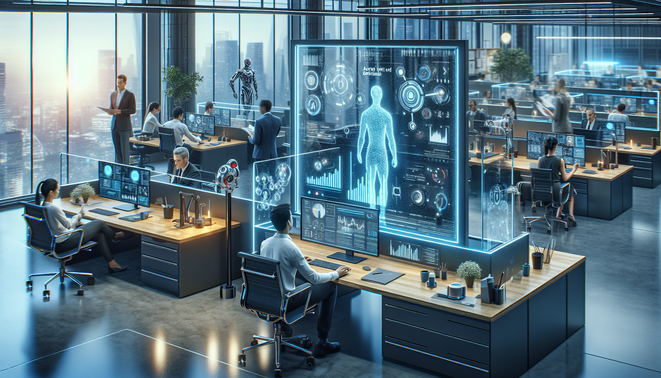
Imagine walking into a warehouse where hundreds of robots glide between aisles, their mechanical arms selecting and packing products with inhuman precision. A year ago, these robots could only follow pre-programmed routes. Today, powered by NVIDIA’s latest Physical AI technology, they navigate unexpected obstacles, adapt to new products without reprogramming, and learn from each other’s experiences. This isn’t science fiction—it’s happening right now in facilities across the globe.
The arrival of Physical AI marks an inflection point comparable to the introduction of assembly lines or personal computers. We’re not just talking about software that generates text or analyzes data. These are AI systems that see, touch, manipulate, and navigate the physical world with increasing sophistication. And unlike previous waves of automation that took decades to mature, this transformation is moving at digital speed. The question facing millions of workers isn’t whether robots will reshape employment, but how quickly—and whether we’ll be prepared when they do.
When AI Gets Physical
The breakthrough enabling this rapid transformation lies in foundation models for robotics—essentially, the ChatGPT moment for physical machines. Just as large language models learned patterns from vast text datasets, these new AI systems learn from millions of simulated interactions with objects, spaces, and scenarios. The result? Robots that can generalize skills across tasks rather than requiring months of custom programming for each new function.
The numbers tell a striking story. Where training a robot for a new warehouse task once required months of engineering work, modern Physical AI systems accomplish the same learning in days or even hours. Companies report break-even points on robot investments shrinking from over five years to just 18-24 months. This economic shift makes automation viable for thousands of businesses that previously couldn’t justify the cost.
Manufacturing facilities are already witnessing this transformation firsthand. Vision-guided robots now handle assembly tasks requiring the kind of hand-eye coordination once considered uniquely human. In warehouses employing 1.8 million Americans, AI-powered systems pick, pack, and organize inventory with minimal human intervention. Fast-food chains are piloting kitchen robots that prepare meals from start to finish. Even hospitals are deploying autonomous systems for medication delivery, sanitation, and logistics.
Perhaps most significantly, these capabilities are no longer exclusive to tech giants. Small and medium manufacturers—the backbone of regional economies—can now access sophisticated automation through robots-as-a-service models. You don’t need a team of AI PhDs anymore; you need a monthly subscription.
The Great Reconfiguration
Let’s confront the uncomfortable reality: somewhere between five and seven million American jobs fall into categories researchers classify as high-risk for automation. Globally, that figure balloons to 40-60 million over the next decade and a half. Warehouse order pickers, assembly line workers performing routine tasks, food prep workers in standardized settings, inventory stockers—these roles face 60-80% automation potential as Physical AI systems mature.
But here’s where the story gets more complex than the dystopian headlines suggest. MIT economist David Autor notes that “technology creates jobs, but not necessarily for the same people.” History bears this out. ATMs didn’t eliminate bank tellers; instead, teller roles evolved toward customer service and relationship management while ATMs handled transactions. Similarly, spreadsheet software didn’t end accounting—it transformed accountants into strategic analysts.
We’re already seeing this pattern emerge with Physical AI. Manufacturing supervisors are becoming robot fleet coordinators, managing hybrid teams of humans and machines. Their days now involve monitoring AI system performance, optimizing workflows, and handling exceptions rather than supervising repetitive human tasks. Warehouse managers are transforming into logistics optimization specialists, focusing on data analysis and strategic planning rather than day-to-day worker oversight. Quality control inspectors are evolving into AI quality assurance specialists who train vision systems and validate algorithmic decisions.
The maintenance technician role offers a particularly instructive example. These positions aren’t disappearing—they’re expanding. Today’s robot service engineers combine traditional mechanical skills with software debugging, sensor calibration, and AI troubleshooting. The role demands more expertise and commands higher wages, but it’s also fundamentally different from what came before.
Entirely new job categories are emerging too. Companies now hire robot trainers who physically demonstrate tasks for AI systems to learn through observation. Physical AI safety engineers test and validate robot behavior to prevent accidents. Human-robot interaction designers optimize collaboration protocols. Workforce transition managers help employees adapt to automation. These roles didn’t exist three years ago; some didn’t exist three months ago.
Research suggests that for every ten jobs directly displaced by automation, three to four new technical positions emerge. That might sound like a net loss, but there’s a critical factor: throughout history, technology has consistently created more economic activity and employment than initial displacement numbers suggest. The challenge lies elsewhere—in the massive skill gap between jobs lost and jobs created, and in the geographic and temporal mismatch between displacement and opportunity.
The Skills That Matter Now
If you’re feeling anxious about AI-powered robots, channel that energy into skill development. The good news: you don’t necessarily need a computer science degree to remain relevant in this new landscape. The better news: some of the most valuable skills are uniquely human.
On the technical side, certain capabilities are becoming foundational across industries. Understanding AI and machine learning fundamentals—not necessarily building models, but knowing how they work, their limitations, and their capabilities—is becoming as important as basic computer literacy was twenty years ago. Familiarity with data analysis tools helps you monitor robot performance and identify optimization opportunities. Even modest programming skills in Python or similar languages can distinguish candidates in roles interfacing with automated systems.
For those pursuing technical careers, deeper specializations command premium salaries. Robotics systems knowledge integrating mechanical, electrical, and software understanding; computer vision expertise; experience with 3D simulation environments like NVIDIA’s Omniverse; and physical AI safety testing capabilities are all high-demand skills with insufficient talent supply. A robotics technician with an associate degree and hands-on experience can earn $60,000-$80,000, while experienced robotics engineers with bachelor’s degrees command six-figure salaries.
But here’s what the data increasingly reveals: uniquely human capabilities are becoming more valuable, not less. Complex problem-solving for novel situations that robots can’t generalize to; emotional intelligence for customer service, team management, and care work; creativity in designing new processes and experiences; strategic thinking about resource allocation and planning; ethical judgment for decisions with moral implications—these skills resist automation precisely because they require consciousness, context, and cultural understanding.
As one management researcher observed, “Robots handle repetition; humans handle exceptions.” The most successful workers in an AI-augmented economy will be those who excel at the irregular, the interpersonal, and the innovative.
Educational pathways are diversifying to match these needs. Traditional four-year degrees in robotics or mechatronics provide deep foundations for engineering roles. But alternative routes are expanding rapidly. Coding bootcamps now offer AI and machine learning specializations in three to six months. Industry certifications like ROS Developer or NVIDIA AI Practitioner provide targeted credentials. Universities are introducing micro-credentials—stackable certificates that build toward expertise without requiring full degrees. Apprenticeship programs, particularly in manufacturing, allow workers to earn while learning.
Major employers are investing heavily in reskilling. Amazon has pledged $1.2 billion to upskill 300,000 workers, focusing on transitioning warehouse employees into technical roles. These corporate initiatives, combined with government workforce development programs and online learning platforms, create multiple entry points for workers seeking to adapt.
The challenge, however, is one of scale and speed. Training a skilled robotics technician requires two to three years minimum. NVIDIA’s technology enables deployment now. Current reskilling programs reach hundreds of thousands annually; millions may need training within a decade. As one education expert warned, “We’re filling an Olympic pool with a garden hose.”
Navigating the Transition
So where does this leave us? Standing at a crossroads, frankly. The technology enabling sophisticated physical AI exists today. The economic incentives for deployment are compelling and growing stronger. The robots are coming—or rather, they’re already here, and their capabilities are expanding rapidly.
But technology’s impact on employment isn’t predetermined. It depends on choices we make collectively and individually. For workers, the imperative is clear: develop skills that complement rather than compete with AI systems. Embrace lifelong learning as a necessity, not a platitude. Seek roles emphasizing judgment, creativity, and interpersonal dynamics.
For employers, the path forward involves designing automation to augment human capabilities rather than simply replace headcount. Companies implementing human-robot collaboration report 40-60% productivity gains compared to full automation—and higher employee satisfaction as physical strain decreases. The businesses that thrive will be those treating workforce development as seriously as technology deployment.
For educators and policymakers, the challenge is massively scaling training programs while ensuring they remain accessible to displaced workers who may lack resources for lengthy retraining. We need creative solutions: portable benefits that support workers through transitions, stackable credentials that allow incremental skill-building while employed, and regional partnerships connecting displaced workers with emerging opportunities.
The warehouse worker whose job is automated in Ohio needs a realistic path to the robot fleet operator position opening in their community—not just a theoretical possibility of retraining for a job in Silicon Valley.
History suggests we’ll ultimately create more opportunity than we destroy. The agricultural revolution displaced farm workers but created industrial jobs. Industrial automation reduced manufacturing employment but expanded service sectors. The digital revolution eliminated countless roles while creating entire industries that didn’t previously exist.
Physical AI will likely follow this pattern—but the transition will be turbulent, uneven, and challenging for millions of individuals even if the aggregate outcome is positive. The question isn’t whether we can adapt to a world of AI-powered robots. Humanity has adapted to every previous technological transformation. The question is whether we’ll make the investments—in education, in worker support, in thoughtful deployment—to ensure that adaptation is humane, inclusive, and broadly shared.
The robot revolution is here. Ready or not, it’s time to prepare for what comes next.