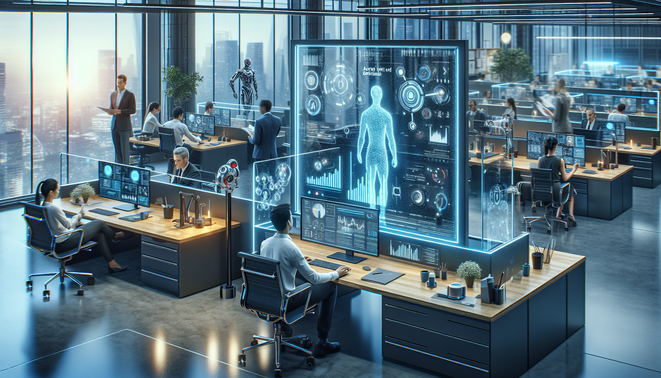
Picture this: A small biotech startup in Boulder connects eight Mac Studios via Thunderbolt 5 cables and suddenly has the computational power to run drug discovery simulations that would have cost them $300,000 in cloud computing fees last year. Their total investment? About $65,000. This isn’t science fiction—it’s happening right now, and it’s fundamentally reshaping not just how we build AI infrastructure, but who gets to build it and what skills they need to make it work.
The arrival of RDMA support on Thunderbolt 5 represents more than an incremental technology upgrade. It’s a democratization moment for high-performance computing, one that’s creating an entirely new category of tech jobs while transforming dozens of existing roles. As distributed AI systems move from data center monopolies to edge deployments accessible to mid-sized companies, the professional landscape is shifting beneath our feet.
The Infrastructure Revolution You Didn’t See Coming
For years, serious AI work required serious infrastructure—the kind that only hyperscalers and well-funded enterprises could afford. RDMA technology changes that equation dramatically. By enabling direct memory-to-memory communication between networked computers without involving processors or operating systems, RDMA slashes data transfer overhead by 40-60% compared to traditional networking. When combined with Thunderbolt 5’s 120 Gbps bandwidth capability, you get something remarkable: enterprise-grade distributed computing built from consumer hardware.
The numbers tell a compelling story. Traditional GPU clusters start at $50,000 and quickly escalate into the hundreds of thousands. Mac-based RDMA clusters are coming in at 20-40% of those costs, and that cost advantage is opening doors. The edge AI computing market is projected to hit $118 billion by 2030, and much of that growth will be powered by organizations that previously couldn’t justify the infrastructure investment.
Healthcare is leading the charge. Hospitals are deploying local AI clusters for medical imaging analysis, keeping patient data on-premises while gaining computational power that was impossible just two years ago. Financial services firms are building edge-based fraud detection systems that operate with latency measured in microseconds rather than milliseconds. Manufacturing facilities are installing factory-floor AI for real-time quality control and predictive maintenance. As one MIT researcher puts it: “We’re seeing a shift to distributed, localized AI infrastructure.”
The Great Job Market Reconfiguration
This infrastructure transformation is creating jobs faster than universities can prepare people for them. Edge AI Infrastructure Engineers—a role that barely existed 18 months ago—are now commanding salaries between $145,000 and $210,000. These professionals design and manage distributed Mac clusters, optimize RDMA configurations, and ensure reliability across decentralized systems. Job postings for “edge computing” skills have increased 35% year-over-year, and that’s just the beginning.
The augmentation-versus-automation debate takes an interesting turn here. Rather than AI systems replacing workers, we’re seeing infrastructure democratization create entirely new professional categories. Distributed AI DevOps specialists automate deployment across edge clusters. Hybrid Cloud-Edge Architects design workload distribution strategies that optimize cost and performance across infrastructure paradigms. Federated Learning Specialists implement privacy-preserving AI training that coordinates across multiple sites while ensuring data governance compliance. These aren’t variations on existing roles—they’re genuinely new disciplines.
But the story isn’t all creation. Traditional data center operations face genuine disruption. Industry analysts estimate a 12-18% reduction in conventional data center roles by 2030, potentially affecting 60,000-80,000 workers in the US alone. Cloud-only infrastructure specialists are discovering their expertise needs significant augmentation to remain relevant. The geographic distribution of jobs is shifting too, dispersing from concentrated tech hubs to wherever organizations deploy edge infrastructure.
The transformation of existing roles may be even more significant than displacement. Network engineers are evolving into Distributed AI Network Engineers, acquiring expertise in RDMA protocols and AI workload characteristics. This transition typically requires 6-12 months of intensive learning. Cloud architects are becoming Hybrid Cloud-Edge Architects, mastering edge computing patterns and latency optimization. Data center operations managers are reinventing themselves as Distributed Infrastructure Managers, learning remote site management and decentralized monitoring. An enterprise IT director captures the shift succinctly: “The total cost of ownership is compelling.”
Yet here’s the challenge keeping executives awake: 67% of AI engineers lack experience in distributed systems architecture. The technology is racing ahead of workforce readiness. Demand for cluster management skills has increased 145% year-over-year, creating a talent shortage that’s driving salaries up and timelines out. Companies are investing $15,000-$25,000 per employee in edge computing upskilling, and even then face a 3-6 month learning curve for traditional IT staff to master distributed AI systems.
The New Skills Currency
If there’s a single insight that matters most for technology professionals, it’s this: hybrid thinking is becoming the most valuable skill in tech. The ability to design across cloud and edge, to make sophisticated workload placement decisions, to architect systems that span multiple infrastructure paradigms—this cognitive flexibility is what separates thriving careers from stagnating ones.
On the technical side, distributed systems architecture has moved from specialized knowledge to foundational requirement. Understanding consensus algorithms, network topology design, and fault tolerance isn’t optional anymore for senior infrastructure roles. RDMA technology and protocols—InfiniBand, RoCE, memory management for remote direct memory access—these are rapidly becoming table stakes. AI and ML engineers need to understand distributed training, data parallelism, model parallelism, and gradient synchronization techniques.
But here’s what’s surprising: the human skills are appreciating faster than the technical ones. Systems thinking—the ability to understand interdependencies and reason holistically about complex environments—is increasingly what distinguishes exceptional practitioners from merely competent ones. Cross-functional collaboration matters more when you’re coordinating across AI, networking, and security teams. Security-first mindsets and sustainability consciousness are shifting from nice-to-have to essential, particularly as distributed systems multiply attack surfaces and energy consumption becomes a critical business concern.
The educational ecosystem is scrambling to catch up. MIT, Stanford, and Carnegie Mellon are launching master’s programs in Distributed AI Systems Engineering. Twelve to sixteen week bootcamps in Edge AI Infrastructure are emerging from organizations like General Assembly. Certification programs are proliferating, though quality varies dramatically. As one university AI lab director warns: “The bottleneck isn’t the technology—it’s finding people.”
For professionals looking to position themselves strategically, the path is reasonably clear. Start with distributed systems fundamentals—there are excellent online courses and books. Get hands-on with RDMA technology, even if it’s just experimental setups. If you’re coming from AI/ML, invest time in understanding how distributed training actually works under the hood. If you’re coming from infrastructure, learn enough about AI workloads to make intelligent architectural decisions. Most importantly, cultivate that hybrid thinking capability—the skill that no amount of automation can replicate.
Navigating the Transformation
We’re at an inflection point where infrastructure is being democratized, jobs are being reconfigured, and skills are being revalued—all simultaneously. This creates anxiety and opportunity in equal measure.
For individual workers, the message is both urgent and hopeful. The transformation is real, the timeline is compressed, but the opportunities are substantial for those who commit to learning. The most successful career moves right now involve pivoting toward the intersection of AI and distributed systems, regardless of which side you’re starting from.
For employers, the talent shortage is acute and worsening. Organizations that invest in comprehensive reskilling programs—giving existing staff 6-12 months of structured learning with hands-on projects—are finding better outcomes than those trying to hire their way out of the skills gap. The most forward-thinking companies are creating internal “AI infrastructure academies” that provide both technical training and real-world deployment experience.
For educators, the challenge is matching pace with industry needs. The lag between identifying required skills and producing graduates with those skills is typically 2-4 years—an eternity in this environment. Programs that emphasize fundamentals and learning agility over specific tools are aging better.
The arc of this transformation bends toward greater access and distribution. High-performance AI infrastructure is escaping the gravitational pull of hyperscale data centers. That’s good for innovation, good for competition, and potentially good for sustainability as we reduce the energy cost of shipping data across continents. It’s disruptive for some roles and some business models, but the net effect appears to be job creation rather than destruction—provided we invest seriously in helping people acquire the skills this new world demands.
The future of work isn’t about humans versus machines. It’s about professionals who understand distributed, edge-deployed, hybrid infrastructure versus those who don’t. The good news? That’s a gap education can close. The question is whether we’ll close it fast enough.