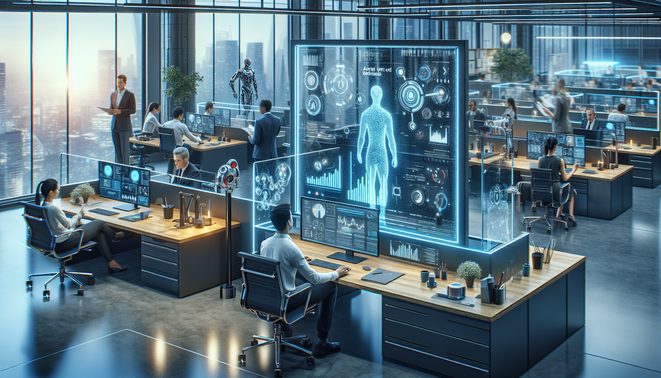
Imagine walking into your office in 2028. Your computer anticipates your needs before you ask, drafts reports while you think, and handles the mundane tasks that once consumed half your day. This isn’t science fiction—it’s the trajectory we’re on right now. As companies like Lenovo unveil AI-integrated business systems at conferences like CES 2026, we’re witnessing the early stages of the most significant workplace transformation since the internet revolution. But here’s the twist: the threat isn’t that AI will replace you. It’s that someone who knows how to work with AI will.
The question keeping executives and workers awake at night isn’t whether AI will change their industry—it’s already happening. The real question is whether they’ll adapt quickly enough to thrive in what’s emerging as a fundamentally restructured job market. With AI-powered personal computers projected to account for 60% of business laptops by 2027, the window for preparation is narrowing fast.
The Transformation Is Already Here
We’re past the point of speculation. AI systems with on-device processing capabilities are reducing task latency from 500 milliseconds to just 50 milliseconds, making real-time AI assistance feel seamless and natural. This technical leap translates into something more profound: knowledge workers using AI tools are seeing productivity gains of 25-40% for specific tasks. That’s not incremental improvement—that’s transformational.
The industries feeling this impact first are those built on information processing. Professional services firms are deploying AI for routine research and document review. Manufacturing facilities are using AI-powered quality control that spots defects invisible to human inspectors. Healthcare providers are leveraging diagnostic assistance systems that flag potential issues in medical imaging. Financial services companies are automating risk assessments that once required teams of analysts.
The enterprise AI market is racing toward $450 billion by 2028, with edge computing—AI that runs on local devices rather than distant servers—representing the fastest-growing segment. Notably, 62% of Fortune 500 companies are already piloting AI PC deployments. But the real surprise is happening in small and medium businesses, where AI adoption grew 180% in 2025 alone. As one technology consultant observed, accessibility through devices like AI PCs is “democratizing technology that was previously only available to large enterprises.”
These aren’t experimental pilots anymore. They’re production deployments changing how actual work gets done right now.
The Great Reconfiguration of Work
Here’s where the conversation gets complicated—and interesting. The World Economic Forum’s latest projections suggest that 85 million jobs may be displaced by AI by 2030, but that 97 million new roles may emerge. That’s a net positive of 12 million jobs, but it’s cold comfort if your specific role is among the 85 million.
The pattern emerging from the data is clear: AI excels at routine, repetitive, and rules-based tasks. Jobs heavily weighted toward data entry, basic bookkeeping, routine customer service inquiries, and invoice processing face significant workforce reductions—potentially 40-60% over the next five to ten years. This isn’t speculation; it’s already visible in hiring trends and automation investments.
But here’s what’s equally true: entirely new categories of work are emerging. AI prompt engineers are commanding salaries between $125,000 and $175,000 to design effective workflows for AI systems. AI ethics officers are being hired to ensure responsible deployment and bias mitigation. AI integration specialists are in high demand to help organizations actually implement these tools effectively. Job postings requiring “AI literacy” have increased 350% year-over-year.
Perhaps most significantly, we’re seeing the transformation of existing roles rather than wholesale elimination. Software developers aren’t disappearing—they’re spending less time writing routine code and more time on system architecture and code validation. Marketing specialists are shifting from manual content creation to strategic direction and AI output refinement. Financial analysts are moving from data compilation to interpreting AI insights and making strategic recommendations. Administrative professionals are evolving from scheduling and data entry to executive support and complex project coordination.
A labor economist studying these shifts put it succinctly: “We’re not seeing wholesale job elimination, but dramatic job transformation.” The distinction matters. Transformation can be navigated; elimination requires entirely new paths.
The augmentation versus automation debate is really about which tasks within a job can be enhanced versus which can be fully automated. Most jobs contain both. The radiologist’s job of reviewing medical images gets augmented—AI highlights potential concerns, but the physician makes the diagnosis and communicates with patients. The bookkeeper’s job of invoice entry gets automated—but financial oversight and advisory work remains human.
The New Essential Skills
If AI handles routine tasks, what becomes valuable in human workers? The research points to a fascinating inversion: the most human capabilities become the most economically valuable.
First, everyone needs foundational AI literacy. This doesn’t mean becoming a programmer—it means understanding what AI can and cannot do, designing effective prompts, interpreting outputs critically, and validating results. Think of it as the modern equivalent of computer literacy in the 1990s. Within a few years, “Can you use AI tools effectively?” will be as basic a job requirement as “Can you use email?”
Second, advanced human skills are appreciating in value. Complex problem-solving that requires navigating ambiguity and novel situations. Critical thinking that can detect biases and evaluate information quality. Creativity in generating truly new ideas rather than recombining existing ones. Emotional intelligence for understanding and managing human dynamics. Ethical judgment for navigating moral complexities. These capabilities are difficult to automate precisely because they’re deeply human.
Third, hybrid expertise combining domain knowledge with technical capability is becoming a powerful differentiator. Healthcare professionals with health informatics training. Manufacturing engineers who understand AI maintenance. Lawyers with legal tech specialization. Teachers with educational technology expertise. These combinations create unique value that pure specialists on either side cannot match.
As one chief learning officer at a Fortune 500 company noted, “The half-life of technical skills is now less than three years.” The implication is profound: we need to teach people how to learn, not just what to learn. Adaptability itself is becoming a core competency.
For workers navigating this transition, the pathway forward involves several practical steps. Seek out AI literacy training through short courses, many of which are now 3-6 months long. Experiment with AI tools in low-stakes situations to build familiarity. Identify which aspects of your current role are uniquely human and double down on developing those capabilities. Look for opportunities to combine your domain expertise with technical skills. Most importantly, adopt a continuous learning mindset rather than viewing education as something that ended with your degree.
Educational institutions are scrambling to adapt, though perhaps not fast enough. Universities are launching interdisciplinary programs combining technical and human skills. Companies are increasing learning and development budgets by an average of 6% in 2026. Apprenticeship models are experiencing a renaissance as the traditional four-year degree proves necessary but insufficient for career-long success.
Navigating the Path Ahead
We’re in the messy middle of a major transition, and honest assessment requires acknowledging both the opportunities and the challenges. The opportunities are real: productivity gains that could increase prosperity, democratization of powerful tools, elimination of tedious tasks that made work feel meaningless, and creation of new roles that didn’t exist before. Workers who successfully leverage AI are seeing significant career benefits.
But the challenges are equally real. Seventy-three percent of workers report needing retraining to use AI tools effectively, yet many organizations are buying the technology without clear implementation strategies. Fifty-eight percent of small business owners worry about employee resistance to change. Sixty-eight percent of workers express anxiety about AI’s impact on their roles. The productivity gains are unevenly distributed, risking widened inequality between AI-enabled workers and those left behind.
The timeline matters critically. Experts suggest organizations have approximately three to five years to prepare their workforce—a window that feels inadequate given the scale of transformation required. The transition won’t be instantaneous, but it won’t be leisurely either.
For different stakeholders, the path forward requires specific actions. Workers should start building AI literacy now, identify their unique human value proposition, and embrace continuous learning. Employers need structured transition programs that include transparent communication, upskilling opportunities, and redesigned workflows—companies doing this see three times better retention rates. Educational institutions must update curricula faster and embrace interdisciplinary approaches. Policymakers need to consider portable benefits, training incentives, and safety nets for those caught in the transition.
The most successful organizations are those positioning AI as augmentation rather than replacement and investing heavily in their people. As a Harvard Business School professor studying AI transformations noted, successful implementations all “involved workers in the design process from the beginning.”
We’re not headed toward a jobless future, but we are headed toward a future where work looks fundamentally different. The question isn’t whether AI will reshape your industry—it will. The question is whether you’ll be among those who shape how that happens, or among those scrambling to catch up. The tools are here. The transformation is underway. And the workers who thrive will be those who learn to dance with the machines rather than compete against them.