When AI Watches the Watchers: The New Jobs Emerging from America’s Biometric Border
Imagine walking through an airport terminal while an artificial intelligence scans your face against a database of billions of images scraped from the internet—all without your explicit consent. This isn’t a dystopian thought experiment. It’s happening now at U.S. borders, where Customs and Border Protection has contracted with Clearview AI to deploy facial recognition for “tactical targeting.” But here’s what most people miss in the heated privacy debate: this technology is quietly rewriting the job market in ways that extend far beyond border security. We’re witnessing the birth of entirely new professions while watching others fade into obsolescence. The question isn’t whether AI will transform work—it’s whether we’re preparing people for the transformation already underway.
The Surveillance-Industrial Complex Goes Mainstream
Facial recognition technology has leaped from science fiction to standard operating procedure with breathtaking speed. Clearview AI’s system can match a single photo against billions of images in seconds, pulling data from social media platforms and public websites to build what amounts to a private surveillance network now accessible to federal agents. This represents more than just a privacy flashpoint—it’s a preview of how AI will permeate high-stakes decision-making across industries.
The biometric technology sector is projected to balloon into a $55-68 billion market by 2027, driven not just by government contracts but by private-sector adoption in finance, healthcare, and retail. Border security is simply the testing ground. What works at ports of entry will eventually migrate to corporate campuses, apartment buildings, and public spaces. Each new deployment creates a ripple effect through the labor market, generating demand for specialists who can build, monitor, and regulate these systems.
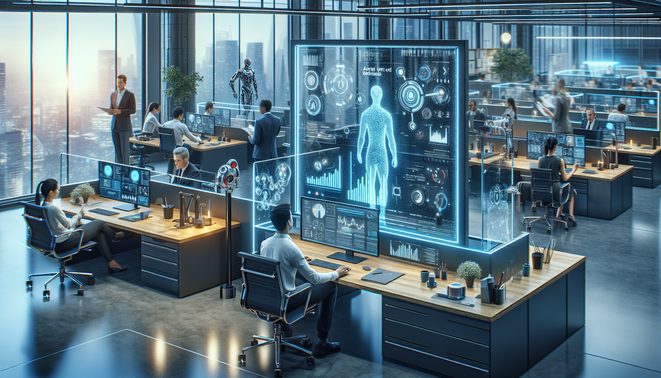
The transformation is most visible at the border itself, where the nature of security work is fundamentally changing. Officers who once relied primarily on document examination and gut instinct now monitor AI-generated alerts and verify automated matches. The technology doesn’t replace human judgment—it reframes it. The officer becomes less investigator and more interpreter, translating algorithmic outputs into operational decisions. This pattern of human-AI collaboration is becoming the template across industries.
The Great Reconfiguration: Who Wins and Who Loses
The employment impact of surveillance AI defies simple narratives. Yes, jobs are being displaced—particularly entry-level screening positions where work consists of repetitive identity verification. Automated biometric kiosks can process travelers faster than human agents, and AI can query multiple databases simultaneously, work that once required dedicated personnel. The harsh reality is that routine cognitive tasks, long considered safe from automation, are proving vulnerable to machine learning systems.
But the displacement story is only half the picture. The Clearview deal is generating entirely new categories of employment that didn’t exist five years ago. Biometric systems engineers design and maintain the technical infrastructure. AI training specialists curate datasets and work to reduce algorithmic bias—a full-time job given that facial recognition systems have documented accuracy disparities across demographic groups. Computer vision developers refine the algorithms that can pick out a face in a crowd or detect when someone is using a photograph to spoof the system.
Perhaps most intriguing are the accountability roles emerging in response to public concern. AI ethics officers ensure systems comply with evolving guidelines and company principles. Algorithmic auditors test for bias and accuracy issues, serving as internal watchdogs. Privacy compliance managers navigate the complex patchwork of state and federal regulations governing biometric data. As one workforce analyst observed, “Technology ultimately creates more jobs than destroyed,” though the distribution of those opportunities remains deeply unequal.
The transformation cuts across skill levels in unexpected ways. Immigration attorneys now need technical knowledge to challenge AI-based decisions, requesting audit logs and algorithmic explanations. Intelligence analysts who once manually correlated data now manage AI systems that surface patterns automatically—but must maintain the critical thinking to recognize when the machine gets it wrong. Even field technicians need new expertise, troubleshooting edge computing devices that run facial recognition algorithms locally rather than in the cloud.
What’s emerging is a workforce model where humans remain in the loop but play different roles. Instead of performing tasks, workers increasingly supervise systems, handle exceptions, and make judgment calls in ambiguous situations where algorithms falter. A constitutional law scholar captured the broader implication: “Our legal frameworks were not designed for pervasive biometric surveillance.” The same applies to our workforce development systems, which are struggling to keep pace with the skills these new roles demand.
The New Literacy: Skills for the Algorithmic Age
Technical competency is the obvious requirement, but not in the way most people assume. You don’t necessarily need to code neural networks from scratch, but you do need to understand how machine learning systems work, what training data means for accuracy, and how to interpret confidence scores. This applies even to non-technical roles. A border supervisor who can’t grasp the limitations of facial recognition—that it performs worse on certain demographics, that image quality matters enormously, that confidence scores aren’t probabilities—can’t effectively oversee a biometric system.
The really valuable technical skills sit at the intersection of domains. Privacy engineering combines cryptography, systems design, and regulatory knowledge. Biometric data science requires computer vision expertise plus statistics plus domain knowledge about human physiology and behavior. These aren’t skills you acquire in a single degree program; they require continuous learning and cross-disciplinary thinking.
But here’s the paradox: as AI handles more analytical work, distinctively human capabilities become more valuable. Critical thinking—the ability to question AI outputs, recognize edge cases, and override automated recommendations—is essential. When an algorithmic system flags someone for additional screening, an officer needs the judgment to assess whether that recommendation makes sense given context the algorithm might miss. Communication skills matter more, not less, as technical specialists must explain complex systems to policymakers, lawyers, and the public.
Adaptability might be the most crucial skill of all. The regulatory landscape for biometric surveillance remains in flux, with some jurisdictions banning facial recognition while others embrace it. Technology evolves rapidly, with new capabilities and vulnerabilities emerging constantly. Workers who thrive will be those comfortable with ambiguity, capable of learning continuously, and resilient in the face of public scrutiny—because surveillance technology is and will remain controversial.
Educational pathways are scrambling to catch up. Combined degree programs—JD/Computer Science, Public Policy with AI focus—are proliferating. Professional certifications in AI ethics and privacy are emerging, though the field is too new for clear standards. Much of the learning happens on the job, through vendor training and cross-functional collaboration. One thing is clear: the days of front-loading education early in life and coasting on those credentials for decades are over. The surveillance age demands perpetual students.
Navigating the Transition
The CBP-Clearview partnership offers a microcosm of a broader labor market transformation. We’re seeing the familiar pattern of technological change—polarization between high-skill jobs and displacement of routine work—but with new wrinkles. The accountability economy emerging around AI creates opportunities for workers who can bridge technical and humanistic domains. The persistent need for human judgment, even as AI grows more capable, suggests that augmentation rather than full automation will characterize most industries.
For workers, the path forward requires honest assessment of vulnerability. If your job consists primarily of routine information processing or pattern recognition, AI is coming for it—maybe not this year, but soon. The response isn’t fatalism but strategic upskilling. Developing expertise that combines domain knowledge with technical literacy creates defensible positions. Cultivating judgment, creativity, and interpersonal skills builds capabilities that remain difficult to automate.
For employers and policymakers, the challenge is ensuring transitions don’t exacerbate inequality. New jobs in biometric security and AI accountability require substantially more education than displaced screening positions. Without intentional investment in retraining and transition support, we risk creating a permanent class of workers left behind by technological change. The market alone won’t solve this; it requires policy intervention and corporate responsibility.
For educators, the imperative is agility. By the time a traditional curriculum is designed, approved, and implemented, the skills landscape has shifted. Modular credentials, industry partnerships, and emphasis on learning-to-learn may matter more than specific technical training that risks obsolescence.
The surveillance age is here, bringing both peril and possibility. Privacy advocates rightly warn about the trajectory we’re on, while technologists point to legitimate security benefits. But lost in that debate is a parallel conversation about economic opportunity and disruption. The jobs being created around biometric surveillance—from the engineers building systems to the ethicists restraining them—offer a preview of work in an AI-saturated future. Whether that future is broadly prosperous or deeply unequal depends on choices we make now about education, regulation, and who shares in the gains from technological progress. The algorithm is already watching. The question is whether we’re watching out for each other.