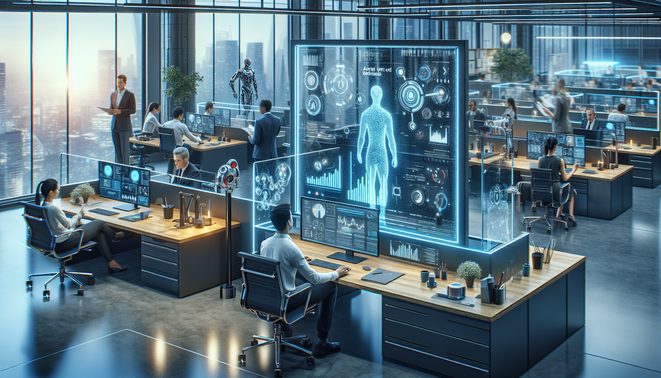
Imagine walking into your office and discovering that your newest colleague never sleeps, never takes vacation, and can process information at speeds that make your fastest team member look glacial. This isn’t science fiction—it’s the reality unfolding in enterprises worldwide as advanced AI systems move from experimental tools to essential infrastructure.
When Anthropic and similar AI companies release increasingly capable systems, the immediate market reaction often involves both excitement and anxiety. Tech selloffs signal investor uncertainty about which companies will thrive in this new landscape. But beneath the market volatility lies a more fundamental question: What happens to human work when artificial intelligence can perform tasks we once thought required uniquely human capabilities?
The answer isn’t simple displacement or utopian abundance. Instead, we’re witnessing the most significant reconfiguration of work since the industrial revolution—one that demands we rethink not just what jobs exist, but what it means to be productively human.
The Transformation Underway
Today’s enterprise AI systems have crossed a critical threshold. They’re no longer limited to narrow, repetitive tasks. Modern large language models can draft complex documents, analyze legal contracts, write functional code, synthesize research across thousands of sources, and engage in nuanced problem-solving that even experts find impressive.
The industries feeling the tremors first are those built on information processing. Customer service centers are deploying AI agents that handle routine inquiries with near-human fluency, escalating only complex emotional situations to human representatives. Software development teams use AI pair programmers that autocomplete entire functions and identify bugs before code reaches production. Legal firms employ AI systems for discovery and contract review, completing in hours what once took associates weeks.
In healthcare, AI documentation assistants capture patient interactions and generate clinical notes, freeing physicians from hours of administrative burden. Marketing departments leverage AI to generate multiple content variations, optimize campaigns in real-time, and personalize messaging at scales previously impossible. Financial analysts use AI to process earnings calls, news feeds, and market data simultaneously, identifying patterns human attention would miss.
But here’s what makes this transformation different from previous automation waves: AI excels at cognitive tasks—the very work that was supposed to be automation-proof. The factory worker displaced by robots could theoretically retrain for knowledge work. Where does the knowledge worker go when AI can read, write, analyze, and reason?
The Job Market Reconfiguration
The conversation around AI and employment often gets trapped in a false binary: will AI take our jobs or not? This frames the question wrong. The more accurate question is: how will AI reshape what jobs are, who does which parts, and what uniquely human contribution becomes?
The data reveals a nuanced picture. Entry-level positions built around routine cognitive tasks—basic data entry, simple customer inquiries, straightforward research assignments, first-draft content creation—face significant compression. Many organizations will simply need fewer people doing these foundational tasks. A customer service operation that once required fifty representatives might function with twenty representatives and AI handling the routine volume.
However, this same AI deployment creates different roles. Companies now hire AI trainers who teach systems company-specific knowledge and appropriate responses. They need AI quality assurance specialists who audit outputs for accuracy, bias, and alignment with brand values. Integration consultants design workflows where AI and humans hand tasks back and forth efficiently. Ethics officers ensure AI deployment aligns with regulations and company values.
The augmentation versus automation debate misses that both happen simultaneously, often within the same role. A customer service representative doesn’t disappear but transforms into an AI-augmented specialist handling complex situations that require empathy, judgment, and creative problem-solving while AI handles routine queries. A software developer doesn’t become obsolete but evolves into an AI-collaborative engineer who directs AI capabilities toward solving higher-level architectural challenges.
As one technology analyst observed: “AI won’t replace workers—workers using AI will replace workers not using AI.” This captures an uncomfortable truth: the transition creates winners and losers not just among companies but among individual workers based on their ability to adapt.
The timeline matters enormously. While AI capabilities advance rapidly, enterprise adoption follows a slower, more uneven path. Regulated industries like healthcare and finance move cautiously. Companies with legacy systems face integration challenges. Smaller organizations lack resources for cutting-edge implementation. This creates a multi-year transition window—compressed compared to previous technological shifts, but not instantaneous.
Skills for the AI Era
If AI handles routine analysis and generation, what human skills become differentiating? The answer reshapes educational priorities and professional development.
On the technical side, AI literacy becomes as fundamental as computer literacy became in the 1990s. Professionals need to understand what AI can and cannot do, how to interact with it effectively, and how to evaluate its outputs critically. Prompt engineering—the ability to frame requests that generate useful AI responses—emerges as a surprisingly valuable skill. Workers who master AI collaboration tools gain significant productivity advantages over those who resist them.
Data interpretation grows more crucial, not less. AI generates insights at unprecedented volume, but humans must evaluate which insights matter, what context affects their validity, and how to apply them to strategic decisions. The ability to ask better questions becomes more valuable than the ability to find answers, since AI increasingly handles the finding.
Yet the most dramatic value appreciation happens with distinctly human capabilities. Emotional intelligence and empathy become premium skills as routine interactions shift to AI, leaving humans to handle complex interpersonal situations. Creative problem-solving—not executing known solutions but defining novel approaches to unprecedented challenges—represents work AI cannot yet replicate. Strategic vision, ethical reasoning, relationship building, and nuanced judgment all increase in organizational value.
Educational pathways must evolve accordingly. Traditional four-year degrees still matter but need updating to incorporate AI collaboration throughout curricula. Micro-credentials and continuous learning replace the “learn once, work for decades” model. Programs teaching human-AI collaboration emerge. Professional reskilling initiatives become essential infrastructure, not nice-to-have benefits.
Workers face an uncomfortable imperative: continuous adaptation becomes a permanent career requirement. The half-life of specific skills shrinks. What you learned three years ago may be partially obsolete. What you learn today might be outdated in five years. Success belongs to those who embrace perpetual learning.
The Path Forward
We stand at a genuine inflection point. The AI systems being deployed today will reshape work more dramatically than any technology since the internet—arguably since electricity. This creates both extraordinary opportunities and serious risks.
The optimistic scenario sees AI augmenting human capability, handling drudgery while freeing people for creative and interpersonal work that provides greater satisfaction. Productivity gains translate to economic growth, shorter workweeks, and broader prosperity. Workers adapt through reskilling programs, finding roles that leverage their irreplaceable human qualities.
The pessimistic scenario sees concentrated benefits flowing to technology companies and capital owners while displaced workers struggle through inadequate safety nets. Economic gains don’t distribute broadly. Job quality degrades as workers compete for fewer positions with less leverage. Inequality accelerates.
Which future we get depends on choices made now by multiple stakeholders. Workers must invest in continuous learning and AI skill development while advocating for transition support. Employers should treat workforce adaptation as strategic investment, not cost-cutting opportunity. Educators need to reimagine curricula around human-AI collaboration and distinctly human skills. Policymakers must consider updated safety nets, reskilling infrastructure, and frameworks ensuring AI benefits distribute broadly.
The jobs of the future won’t simply be “what robots can’t do.” They’ll be roles we’re only beginning to imagine—positions leveraging AI capabilities in ways we haven’t conceptualized yet, solving problems we don’t yet recognize, in industries that don’t yet exist. Human creativity, judgment, empathy, and strategic vision remain irreplaceable. But the premium goes to those who pair these qualities with AI fluency.
The great reconfiguration is underway. The question isn’t whether AI will change work—it already has. The question is whether we’ll shape that transformation thoughtfully, ensuring it enhances rather than diminishes human potential. That remains very much in our hands.