Imagine walking into your office on Monday morning to find your desk cleared and an email explaining that an AI system will now handle your responsibilities—at a fraction of the cost and with zero lunch breaks. For millions of workers worldwide, this isn’t a dystopian fantasy. It’s an increasingly plausible reality that explains why 62% of employees now fear AI will negatively impact their job security within five years.
The backlash against artificial intelligence isn’t about technophobia or resistance to progress. It’s about survival. While tech CEOs marvel at efficiency gains and productivity metrics, workers are watching their livelihoods hang in the balance. This disconnect—between boardrooms celebrating AI adoption and break rooms filled with anxiety—represents one of the most critical economic fault lines of our generation.
The question isn’t whether AI will reshape the workforce. It’s already happening. The real question is whether we’re prepared for what comes next.
The Transformation Is Already Here
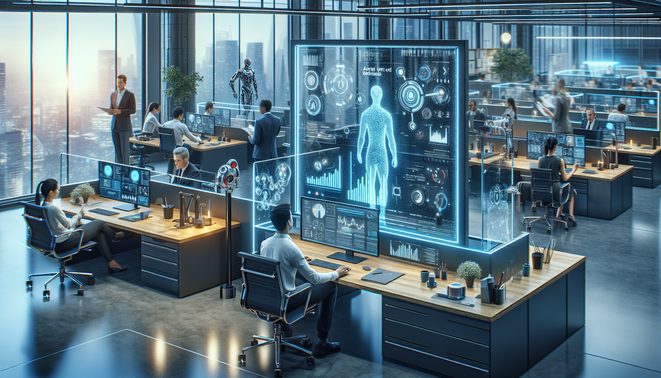
Advanced AI systems have moved far beyond simple automation. Today’s enterprise AI can write marketing copy, generate financial analyses, create artwork, diagnose diseases, and even write software code. These aren’t experimental prototypes—they’re deployed tools transforming how work gets done across every major industry.
The numbers tell a sobering story. More than half of all organizations have now adopted AI in at least one business function, a dramatic leap from just 20% seven years ago. Goldman Sachs estimates that 300 million full-time jobs globally could be affected by AI automation, while 47% of companies surveyed are planning to reduce headcount specifically because of AI implementation over the next three years.
Customer service centers are replacing human agents with chatbots that handle thousands of conversations simultaneously. Media companies are experimenting with AI-generated articles and images. Law firms deploy AI systems to review documents that once kept teams of paralegals employed for weeks. Software development teams increasingly rely on AI coding assistants that can write entire functions in seconds.
The creative industries—once thought immune to automation—find themselves on the front lines. Writers and artists have organized resistance movements, winning contractual protections against AI replacement. Their concerns aren’t abstract. When AI systems can produce a magazine-quality illustration in thirty seconds or draft a serviceable article in minutes, the economic logic of hiring humans becomes harder to justify to shareholders demanding maximum efficiency.
The Job Market’s Violent Reconfiguration
The workforce disruption ahead won’t distribute pain equally. Customer service representatives, data entry clerks, basic content writers, junior developers, and bank tellers face the highest displacement risk—potentially 7 to 8 million jobs in these categories alone. These aren’t just statistics. They’re people with mortgages, families, and decades of specialized experience that may suddenly become obsolete.
Tech optimists point to historical precedents, noting that previous technological revolutions ultimately created more jobs than they destroyed. The World Economic Forum projects 69 million new jobs created by 2027, against 83 million displaced. But these numbers obscure a troubling reality: the new jobs concentrate in high-skill areas requiring advanced technical literacy, while displaced workers often lack pathways to retrain. As one economist bluntly stated, “We’re seeing displacement without adequate reskilling infrastructure.”
The augmentation versus automation debate rages among experts. Will AI enhance human workers, making them more productive? Or simply replace them? The truth appears to be both, depending on the role. Radiologists aren’t disappearing, but they’re evolving into interpreters of AI-generated diagnostics. Journalists continue writing, but increasingly focus on investigative work and human-interest stories that AI can’t replicate, while AI handles routine reporting.
Marketing professionals offer a revealing case study. Template-based graphic design work is rapidly moving to AI systems. But strategy, brand storytelling, and understanding subtle human psychology remain firmly human domains. The marketer who learns to direct AI tools survives and thrives; the one doing only execution-level work faces replacement. This pattern repeats across industries: the future belongs to humans who can effectively collaborate with AI, not those competing against it.
Yet only 27% of organizations report having strategies for workforce transition, even as they rush to implement AI. This recklessness should alarm everyone. Companies are automating faster than they’re upskilling, creating a dangerous gap where workers find themselves stranded—displaced from old roles without preparation for new ones. One Harvard Business School professor captured the fundamental tension perfectly: “CEOs see efficiency gains; workers see pink slips.”
Skills That Will Matter in the AI Era
The skills landscape is undergoing tectonic shifts. Technical capabilities that seemed specialized five years ago are becoming baseline requirements. AI literacy—understanding how these systems work, their limitations, and appropriate use cases—is transitioning from nice-to-have to essential. Data analysis, prompt engineering, and basic programming knowledge are increasingly expected even in non-technical roles.
But here’s the paradox: as AI handles more technical tasks, uniquely human capabilities become exponentially more valuable. Critical thinking, emotional intelligence, creative problem-solving, and complex communication can’t be automated. An AI can generate a hundred marketing slogans, but it can’t read a room, sense when a negotiation is going poorly, or craft a message that resonates with a grieving community.
The workers who will thrive aren’t necessarily those with the most technical skills. They’re those who combine domain expertise with AI collaboration abilities and strong human skills. A financial analyst who understands both market dynamics and how to leverage AI tools for pattern recognition becomes invaluable. A teacher who uses AI to handle administrative work while deepening student relationships and fostering critical thinking becomes irreplaceable.
This requires a fundamental mindset shift toward continuous learning. Technical skills now have a half-life of roughly 2.5 years—what you learned in college may be obsolete before you finish paying student loans. The ability to rapidly acquire new competencies, adapt to unfamiliar tools, and think across disciplines matters more than any single skill set.
Unfortunately, our education and training infrastructure hasn’t caught up. Only a third of workers have access to AI-related training through their employers. Traditional education lags five to ten years behind industry needs. Community colleges and vocational programs lack funding for rapid reskilling. This gap creates what some experts fear could be a lost generation—workers displaced too early to retire but perceived as unable to retrain, falling through the cracks while new opportunities pass them by.
Charting a Path Forward
The AI transformation of work is neither inherently good nor bad—it’s inevitable. The outcomes depend entirely on the choices we make now. Workers need to take agency over their futures by aggressively pursuing AI literacy and cultivating skills that complement rather than compete with automation. Employers must invest in reskilling, not just technology—ideally three dollars in training for every dollar spent on AI systems. Policymakers need to create safety nets and transition programs for displaced workers before the crisis becomes acute.
The tech industry bears particular responsibility. As one union organizer noted, “AI isn’t the problem—it’s being deployed against workers rather than with them.” The most successful AI implementations involve workers in deployment decisions from the beginning, creating tools that augment rather than eliminate jobs.
We stand at a crossroads. One path leads to widening inequality, mass displacement, and social upheaval. The other leads to shared prosperity, where AI handles drudgery while humans focus on meaningful work that leverages our creativity, empathy, and strategic thinking. The difference between these futures isn’t technological—it’s about who benefits from the productivity gains and whether we build systems that support workers through the transition.
The backlash against AI isn’t irrational fear. It’s a rational response to watching innovation proceed without adequate concern for human cost. Tech CEOs wondering why workers aren’t excited about AI might start by asking whether those workers will have jobs, income, and dignity on the other side of this transformation. Until that answer is clearly yes, expect the resistance to grow.