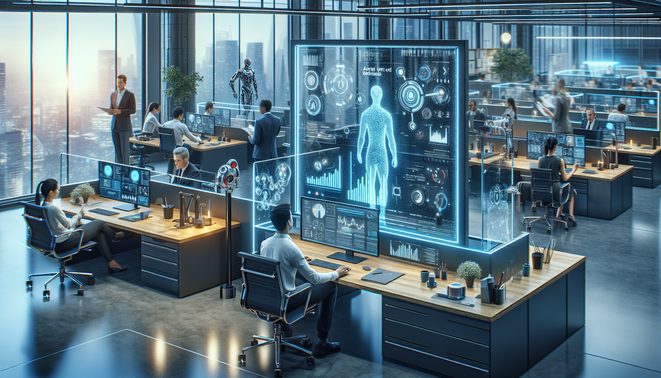
In 2024, companies spent over $200 billion on artificial intelligence infrastructure. Yet when surveyed, 80% of these same organizations admit they can’t clearly measure the business value they’re getting in return. This isn’t just a case of buyer’s remorse—it’s a symptom of something far more profound: we’re living through a massive contradiction where the technology works brilliantly, but our workplaces aren’t ready to change.
This disconnect reveals something crucial about the future of work. The conversation shouldn’t be about whether AI will take your job. The real question is how quickly you can learn to work with AI—because someone who does will absolutely take your job if you don’t.
The Enterprise AI Revolution Is Already Here
Walk into any modern tech company today and you’ll find developers writing code 40% faster using AI assistants. Call a customer service line and there’s a 70% chance an AI handled your inquiry before you ever reached a human. Apply for a loan and algorithms have already assessed your risk profile before any person reviews your application.
The transformation is happening fastest in industries built on information work. Financial services firms are automating bookkeeping and fraud detection. Legal departments use AI to review contracts in minutes rather than days. Healthcare systems deploy diagnostic algorithms that can spot patterns human eyes miss. Marketing teams generate dozens of content variations in the time it once took to write a single email.
But here’s where it gets interesting: despite this technological capability, 70% of AI projects never move beyond the pilot stage. The technology isn’t the bottleneck anymore—organizational culture is. Companies know they should transform, but they’re discovering that changing how people work is infinitely harder than installing new software.
What’s Really Happening to Jobs
The headlines scream about job displacement, and the fears aren’t entirely unfounded. The World Economic Forum projects 83 million jobs will be displaced or fundamentally transformed by 2027. Data entry clerks, basic bookkeepers, and routine customer service roles face automation rates between 60-90%.
But that’s only half the story. The same report predicts 69 million new jobs will be created in the same timeframe. The net loss—14 million positions—is real but manageable if we handle the transition intelligently.
What we’re really seeing isn’t job elimination so much as job evolution. Consider what’s happening to software developers. Junior developers who once spent days writing routine code now use AI to generate it in minutes. This hasn’t eliminated developer jobs—demand for AI-skilled engineers grew 344% last year. But the role itself has fundamentally changed. Modern developers are becoming architects and orchestrators, designing systems and managing AI tools rather than typing every line of code themselves.
The pattern repeats across industries. Financial analysts still have jobs, but AI now handles the data crunching while humans focus on strategy and client relationships. Customer service representatives aren’t disappearing—they’re evolving into customer experience specialists who handle the complex, emotionally nuanced situations that AI can’t navigate.
As MIT economist Daron Acemoglu puts it: “Someone using AI will take your job” if you don’t adapt. The division isn’t between humans and machines—it’s between humans who leverage AI and those who don’t.
This creates what researchers call a “barbell economy.” High-skilled workers who can effectively use AI tools are commanding salary premiums of 40-60% above their peers. Meanwhile, workers in routine cognitive roles face displacement or wage stagnation. The comfortable middle is hollowing out.
The Skills That Matter Now
If you’re wondering how to stay relevant, the answer isn’t to become a machine learning engineer—though that certainly helps. The most valuable skills in the AI era fall into two categories: AI literacy and irreplaceably human capabilities.
On the technical side, basic AI literacy is becoming as fundamental as computer literacy was in the 1990s. This doesn’t mean you need to code neural networks. It means understanding how to effectively prompt AI tools, interpret their outputs, and recognize their limitations. Think of it as learning to be a great manager—of artificial employees. Companies report that workers can develop functional AI tool proficiency in just one to two months of focused practice.
Data literacy matters increasingly. As AI generates more analysis, humans need to evaluate whether those insights actually make sense. Can you spot when an algorithm’s recommendation doesn’t account for real-world context? Can you visualize data in ways that tell compelling stories? These skills now separate valuable employees from replaceable ones.
But here’s the twist that catches many technologists by surprise: the most valuable skills are becoming the most human ones. As Microsoft CEO Satya Nadella notes, “The most valuable skill is learning how to learn.” Everything else flows from adaptability.
Emotional intelligence—once dismissed as a soft skill—is now a critical competitive advantage. AI can analyze customer sentiment, but it can’t build the kind of trust that comes from genuine human empathy. It can generate marketing copy, but it can’t understand the cultural nuances that make a message resonate across different audiences. It can draft legal documents, but it can’t read the room during a tense negotiation.
Critical thinking becomes essential in a world flooded with AI-generated content. Someone needs to evaluate whether the AI’s output is accurate, appropriate, and aligned with larger strategic goals. Complex problem-solving—the kind that requires understanding ambiguous situations and making judgment calls with incomplete information—remains firmly in human territory.
The path forward for workers isn’t to compete with AI at what it does well. It’s to double down on distinctly human capabilities while learning to leverage AI for everything else.
Building Your AI-Era Career
The traditional model of learning once and working for 40 years is dead. Technical skills now have a half-life under five years, which means continuous learning isn’t optional—it’s the job.
For individuals, this means embracing what educators call “learning agility.” Start using AI tools in your current role immediately, even if your company hasn’t officially adopted them. Spend 30 minutes daily experimenting with ChatGPT, Claude, or industry-specific AI platforms. The goal isn’t mastery—it’s familiarity and comfort with the technology.
Invest in hybrid skills that combine domain expertise with AI literacy. The most valuable professionals won’t be pure technologists or pure domain experts—they’ll be people who understand both. An accountant who understands AI is more valuable than an AI expert who knows nothing about accounting.
For companies, the imperative is equally clear: invest in human capital as aggressively as you invest in AI technology. The organizations winning the AI transformation aren’t those with the best algorithms—they’re those with the best change management. That means training programs, cultural shifts, and leadership that models adaptability.
For policymakers and educators, the challenge is reimagining how we prepare people for work. Traditional four-year degrees still matter, but they need supplementation with micro-credentials and continuous reskilling programs. We need educational models that teach people how to learn, not just what to know.
The contradiction in today’s AI market—massive investment alongside implementation struggles—isn’t a sign of failure. It’s a sign of growing pains as we figure out how humans and AI work together most effectively. “Technology works, organizations aren’t ready,” as change management experts observe. Closing that gap is where the opportunity lies.
The future of work isn’t humans versus AI. It’s humans augmented by AI, continuously adapting, focusing on what we do best while letting technology handle the rest. The workers who thrive won’t be those who resist change or those who become machines themselves. They’ll be those who stay fundamentally human while becoming fluent in the tools that are reshaping every industry.
The career you have in five years might not exist today. And that’s not a catastrophe—it’s an invitation to evolve.