The Algorithm Will See You Now: Navigating Careers in the AI Hiring Era
Imagine spending hours perfecting your résumé, tailoring it to a dream job, only to be rejected in seconds by an algorithm you’ll never meet. For three out of four job seekers today, this isn’t a hypothetical—it’s reality. Artificial intelligence now stands as the first gatekeeper to employment at most major companies, making split-second judgments about career trajectories before any human ever sees an application.
This transformation is sparking lawsuits, regulatory scrutiny, and a fundamental rethinking of how we connect talent with opportunity. But beyond the immediate controversy lies a more profound question: What does employment look like when machines decide who gets to work, and what skills matter when algorithms are watching?
The Silent Revolution in Hiring
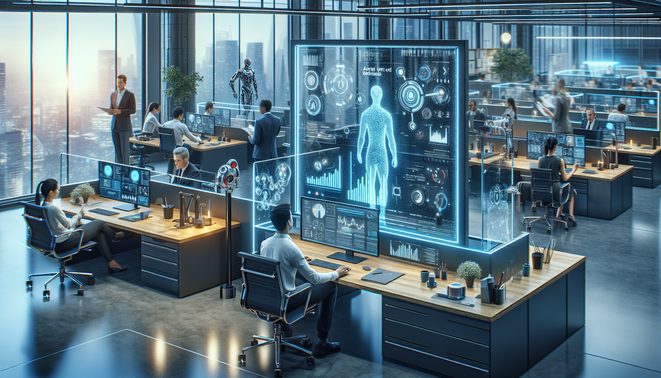
Walk into any Fortune 500 HR department today, and you’ll find something radically different from a decade ago. Ninety-nine percent of these companies now deploy some form of automated screening, using machine learning to parse résumés, predict candidate success, and rank applicants before human eyes ever see them.
The business case is compelling. When a single posting attracts thousands of applications, artificial intelligence offers a seemingly elegant solution: process more candidates faster, identify patterns that predict success, and free human recruiters to focus on relationship-building rather than paper-shuffling. Some companies report reducing their time-to-hire by forty percent.
Yet this efficiency comes with profound complications. Recent lawsuits against AI hiring platforms like Eightfold reveal growing tensions between automation and fairness. Job seekers are pushing back against what they experience as opaque, unaccountable systems that reject them for reasons no one—including their potential employers—can fully explain.
The market for these tools is exploding nonetheless, projected to reach $890 million by 2028. We’re watching in real-time as an entire industry reorganizes itself around algorithmic intermediation, with consequences rippling far beyond HR departments.
Jobs Displaced, Created, and Radically Transformed
The paradox of AI hiring tools is almost darkly poetic: algorithms screen candidates for positions while simultaneously automating away the jobs being filled. Entry-level recruiting coordinators who once manually reviewed applications now find their roles condensed or eliminated. Administrative HR staff watch routine screening tasks vanish into automated workflows.
But the displacement story is only half the picture. New categories of work are emerging at the intersection of human judgment and machine capability. AI ethics officers and algorithmic auditors have become essential roles, conducting bias audits and ensuring compliance with evolving regulations. These specialists verify that hiring algorithms don’t perpetuate discrimination—a concern heightened by research showing AI systems can inadvertently screen out qualified candidates based on employment gaps, non-traditional education, or age-correlated factors.
Talent intelligence analysts now bridge the gap between algorithmic outputs and human decision-making, interpreting what the machines recommend and knowing when to override them. As one Fortune 500 chief human resources officer noted, the efficiency gains are real, but so are the risks—requiring substantial investment in oversight.
Perhaps most telling is the transformation of roles that aren’t disappearing but evolving beyond recognition. Recruiters increasingly manage AI systems rather than résumés, developing expertise in data interpretation and bias detection alongside traditional relationship skills. Career counselors must now teach job seekers to navigate automated screening, optimizing applications for machine readability while maintaining authentic human appeal.
Dr. Cynthia Rudin of Duke University argues that this complexity is unnecessary: “We can build equally accurate models that are fully interpretable and auditable.” Yet the gap between what’s technically possible and what’s actually deployed continues to widen, creating opportunity for professionals who can operate in this ambiguous middle ground.
The New Skills Economy
If AI is redesigning the gateway to employment, what does it take to pass through? The answer reveals an increasingly bifurcated skills landscape.
On one side, technical literacy becomes non-negotiable—not just for technologists but for anyone navigating modern careers. Job seekers need what might be called algorithmic literacy: understanding how ATS systems parse résumés, which keywords trigger matches, how to format documents for machine readability. This has spawned an entire cottage industry of coaches teaching candidates to “beat the bots,” optimizing their self-presentation for silicon rather than human reviewers.
Yet paradoxically, as machines handle more technical screening, distinctly human capabilities become more valuable. The skills hardest to automate—creative problem-solving, emotional intelligence, ethical judgment, and nuanced communication—command growing premiums. Hiring managers report that once AI filters candidates on technical qualifications, final decisions increasingly hinge on qualities no algorithm can easily assess.
For HR professionals, the learning curve is steep. AI system management, bias detection, and data privacy compliance have shifted from niche specializations to core competencies. Only eighteen percent of companies currently audit their AI hiring tools for bias, but regulatory pressure is mounting. The Equal Employment Opportunity Commission has made clear: “Employers cannot outsource their legal obligations to a vendor.”
This creates demand for hybrid expertise combining technology, ethics, law, and business—skillsets traditional education rarely bundles together. Universities are beginning to respond with interdisciplinary programs, but much of this knowledge is being built in real-time by practitioners navigating uncharted territory.
The educational implications extend beyond individual skills to entire pathway structures. Micro-credentials and skills-based learning gain traction as alternatives to traditional degrees, offering machine-verifiable demonstrations of capability. The career-long learning model becomes not an aspiration but a requirement, with professionals expecting to reinvent themselves multiple times across their working lives.
Navigating the Transformation
So where does this leave us? Standing at an inflection point, certainly, but not a predetermined one. The integration of AI into hiring—and by extension, into work itself—presents genuine opportunities alongside legitimate concerns.
For individual workers, the path forward involves cultivating both technical awareness and irreplaceable human capabilities. Build digital portfolios that showcase actual work, not just credentials. Develop the algorithmic literacy to navigate automated systems while strengthening the relationship skills to bypass them when needed. Embrace continuous learning not as professional development but as baseline career maintenance.
Organizations face a more complex calculus. The efficiency gains from AI screening are substantial and likely irreversible, but so are the legal and ethical risks. Smart companies are implementing human-in-the-loop approaches, using AI to augment rather than replace human judgment. They’re investing in transparency, creating appeal mechanisms, and conducting regular bias audits. Most critically, they’re recognizing that “the algorithm said no” is neither an acceptable explanation nor a legal defense.
Policymakers are gradually catching up, though current frameworks feel increasingly inadequate. Anti-discrimination law designed for human decision-makers struggles to address algorithmic opacity. We need updated regulations that protect workers without stifling beneficial innovation—a balance easier to articulate than achieve.
Perhaps most importantly, we need broader societal conversation about what we want from work and how we connect talent with opportunity. AI hiring tools aren’t inherently good or bad; they’re powerful technologies being deployed within existing systems that already contain inequities and inefficiencies. Whether these tools amplify or ameliorate those problems depends on choices we make collectively about transparency, accountability, and human dignity.
The algorithm is seeing you now. The question is whether we’re seeing it—clearly enough to shape this transformation rather than simply endure it. The jobs of the future are being created today, in the space between human aspiration and machine capability. That space is where the real work begins.