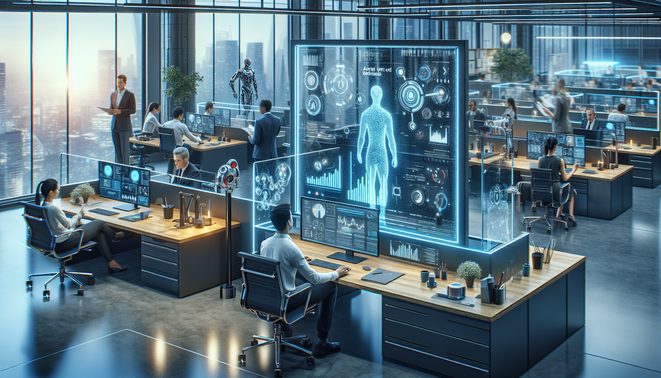
Picture this: It’s Monday morning, and instead of spending three hours building a financial model from scratch, you describe what you need to an AI assistant. Fifteen minutes later, you’re reviewing a sophisticated analysis, tweaking assumptions, and focusing on the strategic insights your CEO actually cares about. This isn’t science fiction—it’s becoming the everyday reality for millions of workers as advanced AI systems reshape how we work.
The deployment of enterprise AI platforms represents the most significant workforce transformation since the internet revolution. But unlike previous technological shifts that primarily automated manual and routine tasks, today’s AI is rewriting the rules for knowledge work itself. The question isn’t whether your job will change—it’s how you’ll adapt to make yourself indispensable in this new landscape.
The Intelligence Amplification Revolution
We’re witnessing a fundamental shift in what machines can do. Modern multimodal AI systems process text, code, images, and data with a sophistication that seemed impossible just years ago. These aren’t simple automation tools—they’re cognitive partners capable of drafting legal briefs, generating production-ready code, analyzing medical scans, and creating marketing campaigns.
The financial services industry offers a glimpse of what’s coming everywhere else. AI systems now handle up to 70% of routine analytical work that once occupied junior analysts for hours each day. Major consulting firms report that tasks requiring 40 hours of human effort two years ago now take 4 hours with AI assistance. A recent economic analysis suggests these technologies could add between $2.6 and $4.4 trillion to the global economy annually.
But the transformation isn’t uniform. Professional services, software development, content creation, and customer service are experiencing the most dramatic changes. In software development, AI coding assistants have become standard tools, with some developers reporting 30-50% productivity increases. Marketing teams use AI to generate dozens of campaign variations in minutes. Legal departments leverage AI for document review that previously required armies of junior associates.
Healthcare, education, and financial advisory are being augmented rather than replaced. AI handles documentation, data analysis, and routine recommendations, freeing professionals to focus on judgment, relationship-building, and complex problem-solving that requires human wisdom and empathy.
The Great Job Reconfiguration
Here’s what the data tells us: we’re not facing simple job elimination—we’re experiencing job evolution on a massive scale. Research indicates that 60-70% of current work tasks could be augmented by AI, but that doesn’t mean 60% unemployment. It means nearly every job is being fundamentally reimagined.
Consider the software developer. Five years ago, the role centered on writing code line by line, debugging syntax errors, and building features from scratch. Today’s developer increasingly acts as an architect and conductor—describing desired functionality to AI systems, reviewing generated code for security and efficiency, and focusing on system design and complex logic that AI struggles with. The job hasn’t disappeared; it’s evolved into something requiring different skills and delivering greater impact.
The same pattern repeats across industries. Content writers transition from creating every word to art directing AI, fact-checking outputs, and adding the human nuance and cultural sensitivity that algorithms miss. Financial advisors shift from portfolio management—increasingly handled by algorithms—to holistic life planning and behavioral coaching. As one Stanford researcher notes, “AI augments human capabilities rather than replacing them.”
New roles are emerging at the intersection of human and machine intelligence. AI prompt engineers optimize how humans interact with AI systems. AI ethics officers ensure responsible deployment. Human-AI collaboration designers create workflows that leverage both human and artificial intelligence effectively. These weren’t job categories three years ago; now they command six-figure salaries.
Yet we must confront the harder truth: some jobs face genuine displacement risk. Data entry clerks, basic bookkeepers, routine transcriptionists, and telemarketers work in roles that AI can handle with minimal human oversight. Economic forecasts suggest 23% of jobs will experience significant changes by 2027, with projections of 69 million jobs created but 83 million displaced—a net loss of 14 million positions globally.
The workers most affected might surprise you. Unlike previous automation waves that hit manufacturing workers hardest, this transformation disproportionately impacts college-educated knowledge workers. White-collar jobs in analysis, research, and professional services face higher AI exposure than many blue-collar positions requiring physical dexterity, situational awareness, or in-person human interaction.
The New Essential Skills
If you’re wondering how to remain valuable in an AI-augmented workplace, the answer lies in developing a hybrid skill set that combines technical fluency with distinctly human capabilities.
AI literacy has become as fundamental as computer literacy was in the 1990s. You don’t need to build AI systems, but you must understand how to work with them effectively—crafting clear prompts, evaluating outputs critically, recognizing limitations and biases, and knowing when human judgment should override algorithmic recommendations. Think of it as a new form of communication skill, as essential as writing a clear email or delivering a presentation.
Data fluency matters across all roles now. You need comfort interpreting visualizations, understanding statistical basics, and questioning data quality and sources. The ability to spot patterns, identify anomalies, and translate data insights into business decisions separates those who thrive from those who struggle.
But here’s the crucial insight: as AI handles more cognitive routine work, uniquely human skills become more valuable, not less. Empathy and emotional intelligence can’t be automated. Complex problem-solving in ambiguous situations where no clear answer exists remains firmly in human territory. Creativity, strategic judgment, ethical reasoning, and the ability to build trust-based relationships—these capabilities command premium value precisely because AI can’t replicate them.
As Microsoft’s CEO observes, “AI augments jobs rather than replacing them entirely.” The workers who flourish will be those who position themselves at the intersection of technical capability and human wisdom—using AI for efficiency while providing the judgment, creativity, and interpersonal connection that only humans can offer.
Education systems are scrambling to adapt. Forward-thinking programs now emphasize AI literacy from elementary school onward, teach computational thinking alongside traditional subjects, and prioritize creativity and critical thinking over memorization. Universities are creating interdisciplinary programs that combine technical skills with ethics, communication, and domain expertise. The future belongs to T-shaped professionals—deep expertise in one area plus broad understanding of how AI tools enhance their work.
Navigating the Transition
We stand at an inflection point. The pessimists see mass unemployment and growing inequality. The optimists envision unprecedented productivity gains and human flourishing as we’re freed from tedious tasks. The reality will likely fall somewhere between, shaped by choices we make today.
For individual workers, the path forward is clear: embrace continuous learning as a permanent mindset. Experiment with AI tools in your current role. Develop skills that complement rather than compete with AI. Build your expertise in areas requiring judgment, creativity, or human connection. The question isn’t whether to adapt but how quickly you can position yourself for the transformed landscape.
For employers, the imperative is investing in workforce development rather than simply replacing humans with AI. Companies that view AI as employee augmentation rather than replacement will build competitive advantages through enhanced human-machine collaboration. Reskilling programs, AI literacy training, and creating new roles that leverage both human and artificial intelligence will separate winners from losers.
For policymakers and educators, the challenge is managing the transition period when job displacement outpaces new job creation. We need educational systems that teach both technical and human skills, social safety nets that support workers during transitions, and policies that ensure AI’s benefits are broadly distributed rather than concentrated among a few tech companies.
The jobs of 2030 will look dramatically different from today’s, but human workers remain essential. We’re not facing human versus machine but rather humans plus machines achieving what neither could alone. Those who learn to dance with AI—leveraging its capabilities while contributing uniquely human value—will find themselves not displaced but empowered, not obsolete but indispensable in the workplace being built right now.