The End of Design As We Know It?
Imagine waking up tomorrow to find that your company’s entire visual design team has been reduced by a third. Not because of poor performance or budget cuts in the traditional sense, but because artificial intelligence can now do in minutes what took human designers hours. This isn’t a dystopian thought experiment—it’s already happening. Google recently slashed its contract graphic design workforce by 35% over eighteen months, citing AI efficiency gains. Meanwhile, freelance platforms report a 22% plunge in icon design job postings. The creative economy, long considered a bastion of irreplaceable human ingenuity, is facing its AI reckoning.
But here’s where the story gets interesting: while some design jobs vanish, entirely new categories are emerging at breakneck speed. Employment in “AI-augmented creative roles” surged 156% year-over-year, according to Reuters labor market analysis. We’re not just witnessing job displacement—we’re watching the complete reconfiguration of what creative work means in the 21st century.
The Transformation Underway
Generative AI has moved from experimental novelty to mission-critical infrastructure faster than perhaps any technology in modern history. Google’s decision to integrate AI-generated icon creation directly into Pixel smartphones—while deliberately blocking manual uploads—signals a profound shift: AI isn’t just an option for design work, it’s becoming the default pathway.
The numbers tell a stark story. AI image generators complete certain design tasks ten times faster than human designers, according to MIT Technology Review research. A startup founder captured the economic reality bluntly: what would have cost $50,000 in designer fees cost his company $200 in AI credits for all their app icons, marketing materials, and UI mockups. This isn’t marginal efficiency—it’s order-of-magnitude disruption.
The impact ripples across industries unevenly. Graphic design services face existential pressure, with traditional agencies hemorrhaging clients to AI-first alternatives. Mobile app developers increasingly handle visual design in-house rather than hiring specialists. Perhaps most concerningly, offshore design hubs in India and the Philippines—built over decades into thriving outsourcing economies—watch as work returns to client countries, not through reshoring but through AI automation.
Yet this same transformation is creating unexpected opportunities. Design agencies aren’t just disappearing; many are pivoting to “AI-augmented” service models. A new breed of AI design consultancies helps companies implement intelligent workflows. Major platforms like Adobe, Figma, and Canva are actively hiring for AI-integrated design positions that didn’t exist two years ago.
The Job Market Reconfiguration
Walk into a design studio today and you’ll encounter a profession in metamorphosis. The International Labour Organization calculates that 40% of visual design tasks are now “highly automatable” with current technology. But here’s the paradox: while routine design work evaporates, demand for designers who can harness AI effectively has never been higher—or better compensated. AI-skilled designers command salary premiums of 25-40% over traditional roles.
The Displacement Reality
Let’s be clear-eyed about who’s most vulnerable. Entry-level and junior graphic designers face a gutted career ladder. Those early-career years, traditionally spent building skills through production work, are precisely where AI excels. Icon designers—the specific focus of Google’s new feature—find their specialized niche almost entirely automatable. One designer told researchers: “I spent years perfecting icon systems. Now an AI generates comparable work instantly.”
Freelance asset creators on platforms like Fiverr report 40% declines in basic design gigs. Production artists and template designers—roles built around repetitive, rules-based work—are simply redundant when AI generates infinite variations in seconds. A survey of 1,200 creative professionals found 43% worried about job security, and their concerns aren’t unfounded.
The Augmentation Opportunity
But dismissing this as simple job destruction misses the more complex reality unfolding. Harvard Business Review research studying 500 companies found those that upskilled designers to work with AI saw 45% productivity gains without layoffs. Companies that simply replaced designers with AI, conversely, reported quality and brand consistency problems within six months. As Professor Michael Torres observed, “Organizations that view AI as replacement rather than augmentation are making a critical strategic error.”
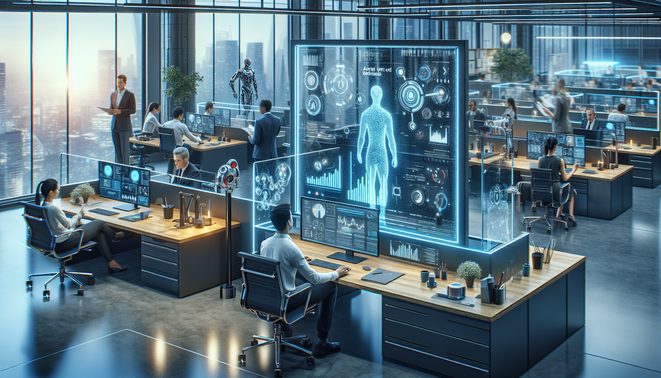
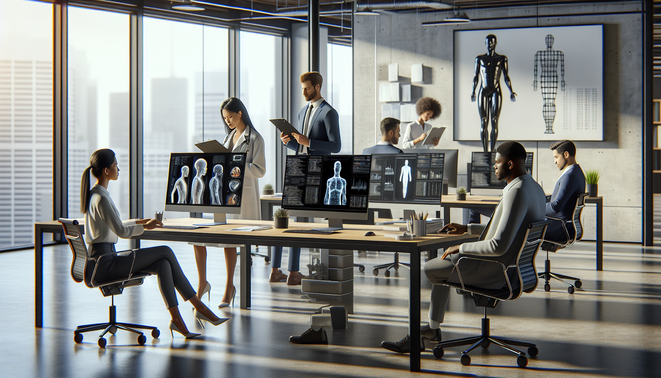
The most successful model emerging: AI for speed and volume, humans for strategy, taste, and brand alignment. This creates transformed roles rather than eliminated ones. Graphic designers become AI-augmented designers, spending fewer hours on execution and more on creative direction. UI/UX designers evolve into experience architects, with AI handling visual iterations while humans focus on user research and complex problem-solving. Brand designers move upstream to become brand strategists, defining parameters for AI systems rather than creating every asset manually.
Entirely New Job Categories
Perhaps most striking is the emergence of roles that simply didn’t exist. AI Prompt Engineers specializing in design craft optimal inputs to generate desired outputs—earning $80,000-$150,000 annually. AI Design Operations Managers establish workflows and ensure brand consistency across AI-generated assets. Generative AI Art Directors curate and direct AI outputs, making high-level creative decisions algorithms can’t navigate.
One particularly important new category: Responsible AI Designers, focused on ensuring AI design systems don’t perpetuate biases or create problematic outputs. As one design director put it, “We’re seeing AI move from experimental tool to core workflow, fundamentally changing what designers do day-to-day.” That change demands new expertise at the intersection of creativity, technology, and ethics.
Skills for the AI Era
The skills gap is real and widening. A design school dean captured the crisis: “Students graduating today need to be AI-native designers, but most programs still teach pre-AI skills.” Educational institutions scramble to update curricula while the ground shifts beneath them.
What matters now? AI literacy for creatives has become foundational—understanding how generative models work, their capabilities and constraints, and how to evaluate output quality. Prompt engineering, once a niche technical skill, is now as fundamental as knowing design software once was. The ability to craft effective prompts, iterate intelligently, and build reusable frameworks separates effective AI-augmented designers from those left behind.
Paradoxically, certain distinctly human skills have become more valuable, not less. Strategic design thinking—user research, insight development, problem framing—remains firmly in human territory. AI can generate variations endlessly but cannot understand why a user might prefer one approach over another or how a design solves a business problem. Dr. Janet Kim at MIT Media Lab frames it perfectly: “The question isn’t whether AI will replace designers, but what parts of design work remain distinctly human.”
The answer increasingly points toward judgment, taste, and strategic thinking. AI curation and quality assessment—knowing when AI output is good enough versus needs human refinement—requires deep design expertise that machines can’t replicate. Understanding brand essence, maintaining creative standards, recognizing edge cases where AI fails: these cognitive skills represent the new competitive advantage.
Technical-creative hybrid capabilities are also ascendant. Designers who understand code, can customize AI workflows, integrate APIs, and architect design systems for AI implementation become invaluable. The barrier between technical and creative work is dissolving; tomorrow’s successful designers straddle both worlds comfortably.
The Path Forward
So where does this leave us? The transformation of creative work through AI is neither unalloyed disaster nor uncomplicated opportunity—it’s both simultaneously, distributed unevenly across roles, regions, and skill levels.
For individual workers, the imperative is clear: develop AI fluency immediately. Experiment with generative tools, build prompt engineering skills, and focus on cultivating judgment and strategic thinking that algorithms can’t match. The designers thriving in this transition aren’t fighting AI—they’re learning to direct it.
For employers, the Harvard research offers crucial guidance: companies that upskill rather than replace, that view AI as augmentation rather than automation, achieve better outcomes. Short-term cost cutting through wholesale designer replacement creates long-term brand consistency and quality problems. The winning strategy treats AI as a powerful tool wielded by skilled humans, not a human replacement.
For educators, the challenge is existential: redesign programs for an AI-native reality or become irrelevant. That means integrating AI tools throughout curricula, teaching prompt engineering alongside design principles, and preparing students for roles that blend technical and creative expertise.
The creative economy isn’t ending—it’s transforming at unprecedented speed. New roles emerge as fast as old ones fade. The designers who navigate this transition successfully will be those who embrace the change, develop hybrid skills, and focus on the irreducibly human elements of creative work. The future of design isn’t human or AI—it’s human and AI, working in ways we’re only beginning to understand.
The icon on your smartphone screen tomorrow might be AI-generated. But the strategic thinking behind your app’s entire user experience? That still requires a human mind. The question for creative professionals isn’t whether to adapt to AI, but how quickly they can learn to harness it while doubling down on the skills that remain uniquely human. That’s not just the future of design—it’s the future of knowledge work itself.