The Great Work Redesign: AI and Tomorrow’s Careers
Imagine walking into your office in 2027 and discovering that your job title no longer exists—not because you’ve been fired, but because your role has evolved so dramatically it needs a new name entirely. This isn’t science fiction. According to the World Economic Forum, 44% of workers’ core skills will be disrupted within the next five years, triggering the most significant workplace transformation since the Industrial Revolution. Yet here’s the paradox: while 83 million jobs may be eliminated by 2027, roughly 69 million new positions will emerge. We’re not facing an employment apocalypse—we’re witnessing a massive reconfiguration of what work means.
The conversation around artificial intelligence and employment has shifted dramatically. We’ve moved past dystopian predictions about robots stealing jobs and entered a more nuanced reality where the question isn’t whether AI will change work, but how we’ll manage that change. The singularity—that hypothetical moment when AI surpasses human intelligence—remains theoretical. What’s not theoretical is the workplace transformation happening right now.
The Quiet Revolution Already Underway
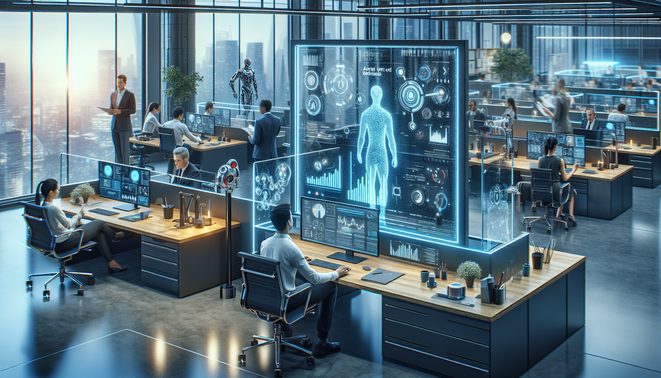
Advanced AI systems have moved far beyond simple automation. Today’s enterprise AI can draft legal contracts, analyze medical images for diagnostic patterns, generate marketing copy, and even write functional code. These aren’t experimental prototypes—they’re tools being deployed across Fortune 500 companies and startups alike.
The financial services sector offers a glimpse into this transformation. Algorithmic systems now handle everything from fraud detection to loan processing, tasks that once required armies of analysts. Back-office operations in major banks are projected to see workforce reductions of 40-50% over the next several years. Meanwhile, healthcare is experiencing something different entirely: AI is reducing administrative burden and enhancing diagnostic capabilities so effectively that the sector anticipates net job growth of 15-20%. The technology isn’t simply replacing workers—it’s enabling the industry to expand services.
Customer service represents perhaps the most visible shift. Sophisticated chatbots now manage routine inquiries that once occupied thousands of call center representatives. Yet this hasn’t meant unemployment for all those workers. Instead, companies are discovering that when AI handles tier-one support, human agents can focus on complex problem-solving and relationship building—work that requires the emotional intelligence and contextual judgment that machines still can’t replicate.
The creative industries are grappling with their own reckoning. Generative AI can now produce marketing materials, compose music, and generate artwork in seconds. Rather than replacing creative professionals entirely, these tools are becoming collaborators—sometimes controversial ones. The most successful creative workers are learning to use AI as an amplifier for their ideas while focusing on the uniquely human elements: cultural insight, emotional resonance, and original strategic thinking.
Redesigning Work, Not Just Eliminating It
The prevailing narrative around AI and employment is often too simplistic. Headlines scream about job losses, but the reality involves far more nuance. McKinsey estimates that generative AI could automate 60-70% of time spent on current work activities, but that doesn’t mean 60-70% unemployment. Most roles won’t be eliminated—they’ll be redesigned.
Consider the evolution of data analysts into what some are calling insight strategists. AI now handles data collection and basic analysis automatically. The human analyst’s role is transforming into something more valuable: interpreting findings, crafting narratives from numbers, and providing strategic recommendations that account for contexts AI can’t grasp. The job isn’t gone; it’s elevated.
Radiologists offer another compelling example. Early predictions suggested that diagnostic AI would make these specialists obsolete. Instead, radiologists using AI-assisted tools are becoming more effective, handling larger caseloads while focusing their expertise on complex cases that require nuanced medical judgment. The technology augments rather than replaces their skills.
This augmentation-versus-automation distinction matters enormously. As one Brookings Institution researcher notes, “whether AI transforms work broadly or concentrates prosperity depends on implementation choices.” Companies and policymakers face genuine choices about whether to use AI to enhance workers or replace them.
Still, some positions face genuine displacement risk. Data entry clerks, telemarketers handling basic calls, routine bookkeepers, and cashiers are seeing automation rates above 70%. These aren’t abstract statistics—they represent millions of workers who will need to transition into different roles. Research shows that workers earning under $38,000 annually are fourteen times more likely to need occupational transitions than higher earners, highlighting how AI’s impact intersects with existing economic inequalities.
But opportunity exists alongside disruption. Entirely new job categories are emerging: AI ethics officers who ensure responsible deployment, prompt engineers who craft effective inputs for generative systems, algorithm auditors who check for bias, and human-in-the-loop coordinators who optimize collaboration between people and machines. These roles didn’t exist five years ago; now they command premium salaries and companies struggle to fill them.
The Skills That Matter Now
If you’re wondering how to remain valuable in an AI-augmented workplace, the answer involves two distinct skill categories—and they’re probably not what you expect.
Yes, some technical literacy matters. Understanding AI fundamentals—not necessarily programming, but grasping conceptually how these systems work—provides crucial context for working alongside them. Data literacy has become nearly as essential as reading comprehension. Workers who can interpret data visualizations, assess data quality, and understand basic statistical concepts will navigate this transition far more successfully than those who can’t.
But here’s the paradox: as AI handles more technical tasks, uniquely human capabilities are commanding increasing premiums. Jobs requiring high levels of creativity, strategic thinking, emotional intelligence, and complex interpersonal interaction face only 15-20% automation risk. Moreover, roles emphasizing these soft skills grew 2.5 times faster than technical positions between 2015 and 2023.
Critical thinking has become essential precisely because AI systems are so prevalent. Someone needs to evaluate whether an AI’s output is accurate, appropriate, and unbiased. Machines can generate content at remarkable speed, but they can’t assess whether that content serves strategic goals or reflects organizational values. That remains human work.
Ethical reasoning represents another increasingly valuable capability. AI systems require constant judgment calls about appropriate use, privacy implications, and fairness considerations. These aren’t technical questions with algorithmic answers—they’re moral questions requiring contextual wisdom.
Perhaps most importantly, adaptability itself has become a core competency. The pace of change means that specific skills learned today may have limited shelf lives. Workers who cultivate learning agility—comfort with ambiguity, willingness to continuously acquire new capabilities—will navigate multiple career transitions far more successfully than those who expect their initial training to suffice for a lifetime.
The education system is struggling to keep pace. Only 16% of workers report receiving AI-related training from employers. Traditional four-year degrees are becoming less relevant for many emerging roles, while micro-credentials, bootcamps, and continuous learning models are gaining traction. The person who graduates from college and considers their education complete is adopting an increasingly obsolete mindset.
Navigating the Transition
So where does this leave us? The AI transformation of work is neither the catastrophe some fear nor the utopia others promise. It’s a transition—and transitions are inherently challenging.
For individual workers, the path forward involves honest self-assessment. Which aspects of your current role could AI handle? Which require your uniquely human judgment? How can you position yourself to work alongside these systems rather than compete against them? Investing in both AI literacy and those durable human skills—creativity, critical thinking, emotional intelligence—isn’t optional anymore.
Employers face their own imperative. Research shows that 70% of companies have AI strategies, but only 23% have implemented workforce transition plans. That gap represents both risk and opportunity. As one Harvard Business Review analysis suggests, “companies that reimagine work to combine human and AI strengths will thrive.” Organizations that view AI purely as a cost-cutting tool may find themselves outcompeted by those that use it to amplify human capabilities.
Policymakers can’t remain on the sidelines either. With up to 12 million occupational transitions potentially needed in the United States alone by 2030, the scale of workforce reskilling required is staggering—McKinsey estimates $1.3 trillion needed globally. Fragmented, jurisdiction-by-jurisdiction approaches to AI governance create uncertainty for workers and businesses alike.
The future of work isn’t predetermined. The same AI technologies can be implemented in ways that broadly share prosperity or concentrate it among a small group of winners. The same tools can either amplify human capabilities or replace human workers entirely. These are choices, not inevitabilities.
What’s clear is that the great work redesign has already begun. The jobs of 2030 will look remarkably different from those of today—some eliminated, many transformed, and entirely new categories emerging. Those who approach this transition with curiosity rather than fear, who invest in continuous learning, and who cultivate both technical literacy and irreplaceable human skills will find themselves not victims of disruption but architects of their own evolving careers. The question isn’t whether work will change. It’s whether we’ll change with it.