The Dawn of AI Agents: Redesigning Work as We Know It
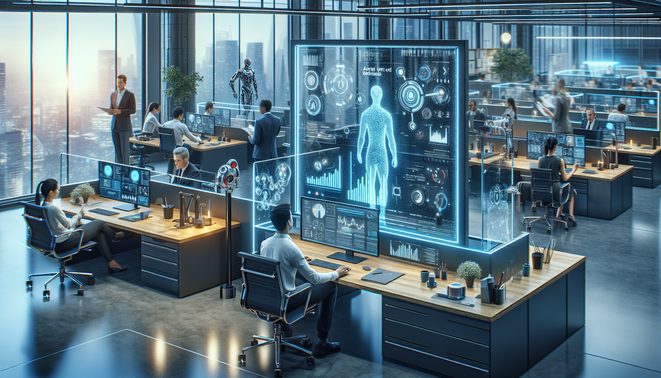
Imagine walking into your office where half your colleagues aren’t human—they’re AI agents autonomously managing customer inquiries, writing code, analyzing market data, and coordinating supply chains. This isn’t science fiction set decades away; it’s the reality unfolding right now as companies like NVIDIA declare AI agents the next fundamental computing platform. Recent estimates suggest these autonomous systems could inject up to $4.4 trillion into the global economy annually, but that staggering opportunity comes with an equally staggering question: what happens to the humans currently doing those jobs? The answer is neither simple replacement nor seamless transition—it’s a wholesale reconfiguration of how we think about work itself.
The Transformation Underway
AI agents represent a quantum leap beyond the chatbots and recommendation algorithms we’ve grown accustomed to. These systems don’t just respond to queries—they independently break down complex objectives into executable tasks, interact with software tools, make contextual decisions, and learn from outcomes. Think of them as digital employees with the ability to work 24/7 without supervision across multiple workflows simultaneously.
The industries feeling this shift first are those built on high-volume information processing. Customer service operations are watching AI agents handle 80-90% of routine inquiries without human involvement, managing complex, multi-step resolutions that would have required escalation just two years ago. In software development, AI coding assistants are evolving into autonomous developers capable of building entire features from written requirements, with human developers increasingly focused on architectural decisions and quality oversight rather than line-by-line programming.
Financial services firms are deploying AI agents for loan approvals, fraud detection, and portfolio optimization—tasks that previously required armies of analysts. One major insurance company reported that AI agents now process 70% of their claims without human review, reducing resolution time from days to minutes. Healthcare administration is similarly transforming, with AI handling patient scheduling, insurance verification, and medical record updates across hospital networks.
The numbers tell a dramatic story: activities consuming 60-70% of current employee time could be automated, and work representing 29-50% of hours across all occupations is technically automatable with existing technology. We’re not talking about future capabilities—these systems are operational today.
The Job Market Reconfiguration
The employment mathematics here are sobering but not apocalyptic. Global workforce analyses project approximately 83 million jobs may be displaced by 2027, while 69 million new positions emerge—a net reduction of 14 million jobs, or roughly 2% of current global employment. But these aggregate numbers mask profound shifts in what kinds of work humans will do.
Data entry clerks, basic customer service representatives, junior developers, and routine administrative assistants face displacement rates between 60-90% over the next six years. That’s not 60% unemployment—it’s 60% fewer people hired into those roles as automation absorbs the work through attrition and organizational restructuring. Approximately 37 million workers globally in these categories will need to transition into fundamentally different work.
Yet simultaneously, entirely new job categories are crystallizing. AI Agent Designers are commanding salaries between $120,000-$250,000 to architect workflows for autonomous systems. Organizations need AI Quality Assurance Specialists to test agent behaviors, Human-AI Collaboration Specialists to optimize hybrid teams, and AI Ethics Officers to establish governance frameworks. Conservative estimates suggest these emerging roles could create 500,000 positions globally within three years.
The more significant transformation, however, isn’t replacement but evolution. As one Harvard Business School analysis observed: “AI agents augment rather than replace most knowledge workers initially.” Customer service representatives are becoming Customer Success Architects who manage AI teams and handle complex escalations. Data analysts are shifting into Data Strategy Directors who frame business questions and interpret AI-generated insights. Software developers are becoming AI-Augmented Developers who direct coding agents and focus on system architecture.
This augmentation story carries its own complications. Research from Stanford reveals that while workers using AI agents are 37% more productive, they show reduced ability to perform tasks without AI assistance—a deskilling effect that raises legitimate concerns about long-term capability development. The tools that make us more efficient may simultaneously make us more dependent.
The timeline matters enormously. This transition unfolds in waves: task automation is happening now, workflow automation arrives through 2026, and complete role transformation extends beyond 2027. Workers have a window—albeit a narrow one—to adapt.
Skills for the AI Era
If AI agents handle routine information processing, what capabilities become distinctly valuable for humans? The answer divides into technical competencies and irreducibly human skills.
AI literacy is becoming as fundamental as computer literacy was in the 1990s. Within three years, approximately 70% of jobs will require workers to understand how AI agents function, when to trust their outputs, and when to override their recommendations. This doesn’t mean everyone needs to understand neural network architecture, but professionals must develop informed skepticism—the ability to spot AI errors, identify biases, and recognize the boundaries of algorithmic competence.
More specialized technical skills are commanding premium compensation. Prompt engineering and agent design—the ability to craft effective instructions and design multi-step workflows for AI systems—is emerging as a distinct profession with 6-12 month learning pathways through specialized bootcamps. Data interpretation skills are similarly critical; AI agents can generate insights at unprecedented scale, but humans must translate those insights into contextual decisions.
The human skills becoming more valuable are those AI cannot easily replicate. Complex problem-solving in ambiguous, novel situations remains distinctly human territory. Emotional intelligence—empathy, relationship building, reading interpersonal dynamics—becomes more valuable as routine interactions are automated. Creative and strategic thinking, ethical judgment, and cross-cultural communication sit at the top of every skills priority list.
Educational institutions are scrambling to adapt. Universities are launching AI collaboration programs, corporations are investing $200 billion in workforce development initiatives, and a cottage industry of AI bootcamps is proliferating. Workers must become aggressive self-educators, treating skill development as continuous rather than front-loaded into formal education years.
The most pragmatic advice: develop T-shaped expertise—deep knowledge in one domain combined with broad AI literacy and strong human skills. A marketing professional who understands campaign strategy, can orchestrate AI marketing agents, and excels at creative direction will thrive. A paralegal who knows legal reasoning, can direct AI research tools, and provides exceptional client service will remain highly employable.
The Path Forward
We stand at an inflection point that demands action from multiple stakeholders. Workers must take ownership of continuous learning, dedicating time to AI literacy and identifying which aspects of their current roles are automatable versus uniquely human. Employers need to move beyond simply deploying AI agents to thoughtfully redesigning work, investing in employee reskilling, and creating career pathways in the augmented workplace.
Policymakers face urgent questions about social safety nets, education reform, and whether the transition speed requires intervention. The historical pattern is clear: technological revolutions eventually create more prosperity and employment, but the transition periods can be brutal for displaced workers without support systems.
As Jensen Huang noted when positioning NVIDIA’s AI agent strategy: “We’re moving from AI that predicts to AI that acts.” That shift from passive tools to autonomous agents represents the most significant workplace transformation since industrialization. The question isn’t whether this future arrives—it’s already here. The question is whether we’ll manage the transition with foresight and equity, or whether we’ll stumble through it leaving millions of workers behind.
The opportunity is genuine: more productive organizations, work freed from drudgery, and human talent redirected toward creativity and problem-solving. But realizing that opportunity requires intentional effort—from individuals investing in new skills, organizations redesigning roles rather than simply cutting headcount, and societies building support structures for workers in transition. The future of work is being written right now, and we all have a role in authoring it.