
Lights, Camera, Algorithm: How AI Is Rewriting Hollywood’s Job Description
Imagine a visual effects artist who spent fifteen years perfecting the craft of rotoscoping—painstakingly isolating objects frame by frame—only to watch an AI system accomplish the same task in seconds. This isn’t a dystopian future scenario; it’s happening right now in production studios across Los Angeles, Vancouver, and London. With over $4 billion flowing into entertainment AI startups in the past eighteen months alone, the film industry stands at an inflection point that will fundamentally reshape who makes movies and how they’re made.
The stakes are enormous. Production costs have climbed 25% over the past decade, pressuring studios to find efficiencies. Meanwhile, AI systems can now generate photorealistic backgrounds in hours rather than weeks and automate editing tasks that once required entire teams. As major studios establish AI innovation labs and production companies race to integrate these tools, one question dominates every conversation from executive suites to union halls: What happens to the people who built this industry?
The New Production Reality
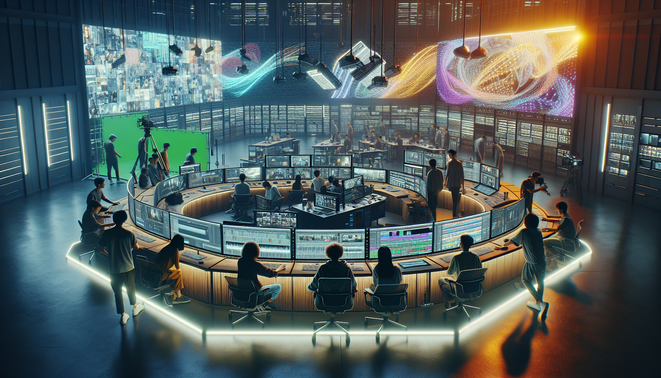
Today’s AI production tools go far beyond simple automation. Generative AI systems can create entire environments from text descriptions, synthesize realistic human performances, and optimize production schedules with sophisticated algorithms. Virtual production technology—combining LED walls with real-time rendering—allows filmmakers to shoot scenes in any location imaginable without leaving the studio. These aren’t experimental technologies anymore; they’re active production tools delivering measurable results.
The numbers tell a compelling story. Studios implementing AI workflows report 15-35% cost savings in post-production, with some VFX budgets dropping by as much as 40%. What once required a hundred-person crew might soon be accomplished by a specialized team of twenty. An AI startup CEO recently claimed that within five years, small teams will produce what currently demands massive production departments.
The visual effects sector feels the pressure most acutely. Already challenged by tight budgets and punishing deadlines, VFX houses now face AI systems that generate backgrounds and environmental elements at unprecedented speed. Animation studios watch as AI handles in-between frame generation—work that traditionally employed armies of junior artists. Post-production facilities see automated color grading and sound mixing tools that complete in minutes what took colorists and sound designers days to perfect.
But the transformation extends beyond technical roles. AI-powered script analysis tools predict content performance, potentially influencing what stories get told. Virtual location scouting eliminates travel costs and time. Automated casting platforms match talent to roles using algorithmic analysis. From pre-production through final delivery, AI touches nearly every phase of filmmaking.
The Great Reconfiguration
The employment impact breaks down into three categories: displacement, transformation, and creation. Understanding this distinction matters enormously for anyone building a career in entertainment.
Jobs facing the highest displacement risk cluster in technical execution roles. Entry-level VFX artists specializing in rotoscoping, cleanup, and basic compositing find their skills increasingly automated. Junior colorists and editors watch AI systems handle routine technical tasks. Background and environment artists, 3D modelers creating standard assets, and production assistants managing scheduling and logging all face significant disruption. Industry estimates suggest 30-50% of these entry-level to mid-level technical positions could disappear by 2030.
Yet this tells only part of the story. Many roles aren’t disappearing—they’re transforming dramatically. VFX supervisors evolve into AI production directors, managing sophisticated workflows rather than creating effects hands-on. Editors become story architects, focusing on high-level narrative design while AI handles technical cuts. As one workforce consultant observed, “The future belongs to those who can direct AI, not compete with it.” Cinematographers blend traditional craft with virtual production expertise. Production designers shift from execution to pure creative vision, directing AI systems to build the worlds they imagine.
These transformed roles require a new skill cocktail: deep creative expertise combined with AI literacy and workflow management capabilities. The bifurcation is clear—high-skill creative directors on one side, automated execution on the other, with the middle increasingly squeezed.
Simultaneously, entirely new roles emerge. AI prompt engineers specialize in directing generative systems to produce specific visual content. Virtual production technicians operate complex real-time rendering systems. AI ethics and compliance officers ensure responsible use and manage rights issues. Synthetic data curators build and maintain training datasets. Digital human designers create and manage AI-generated performances. These roles didn’t exist three years ago; now studios actively recruit for them.
The net employment equation remains contested. Optimists point to historical precedent—every major technology revolution created unforeseen opportunities. Pessimists counter that unlike additive technologies like CGI, AI is fundamentally substitutive, directly replacing human labor rather than enabling new capabilities. The truth likely lands somewhere uncomfortable: significant transitional disruption with eventual stabilization in a reconfigured market that doesn’t necessarily employ the same people who lost jobs.
The Skillset for Tomorrow’s Studios
If the job market is being rewritten, the curriculum must follow. Success in the AI-augmented film industry demands a blend of technical competence, creative mastery, and distinctly human capabilities that machines can’t replicate.
On the technical side, AI literacy becomes non-negotiable. This doesn’t mean everyone needs a computer science degree, but understanding how to prompt and direct AI systems, evaluate their outputs, and integrate them into workflows becomes as fundamental as knowing editing software. Familiarity with real-time rendering engines like Unreal Engine, virtual production systems, and generative AI platforms moves from specialized knowledge to baseline expectation. As one MIT professor noted, film schools must produce “bilingual graduates who speak both the language of art and algorithms.”
Paradoxically, as technical execution becomes automated, human skills grow more valuable. High-level creative vision—the ability to conceive what should be created rather than execute the creation—becomes the primary differentiator. Storytelling and narrative design, artistic taste and aesthetic judgment, strategic creative decision-making: these capabilities define who directs the AI rather than being directed by market forces. When AI can generate technically perfect images, cinematography becomes entirely about the imperfect choices that convey emotion and meaning.
Adaptability itself becomes a meta-skill. The tools will continue evolving rapidly; success belongs to those who embrace continuous learning. Cross-functional collaboration gains importance as creative and technical domains blur. Ethical reasoning grows critical as decisions about AI use carry implications for authenticity, rights, and employment.
Educational institutions are scrambling to adapt. USC’s School of Cinematic Arts now integrates AI production modules. NYU Tisch offers computational filmmaking specializations. Industry partnerships deliver hands-on training with cutting-edge tools. But traditional education pathways can’t keep pace alone. Self-directed learning through online courses, community-driven tutorials, and experimentation with consumer-grade AI tools becomes essential. Mid-career professionals face particularly steep learning curves, requiring significant re-skilling investment.
The skills gap poses real challenges. Many experienced professionals lack AI literacy and face psychological resistance to change. Meanwhile, the entry-level pipeline that traditionally trained newcomers is precisely where automation hits hardest. The industry must solve a puzzle: how to develop the next generation’s expertise when the training-ground jobs are disappearing.
Navigating the Transition
The transformation of film production through AI is neither purely positive nor entirely threatening—it’s inevitable and complex, creating winners and losers unless stakeholders act thoughtfully.
For individual workers, the imperative is clear: develop AI fluency now. Experiment with available tools. Build portfolios demonstrating not just technical skill but the ability to direct AI toward creative visions. Cultivate the human capabilities—taste, judgment, storytelling—that remain difficult to automate. View AI as an amplifier of creative vision rather than competition.
Studios and production companies bear responsibility beyond profit optimization. Investing 5-10% of budgets in workforce development, as some industry experts recommend, isn’t charity—it’s ensuring a skilled talent pipeline. Transparent communication about AI implementation and genuine re-skilling programs build trust and capability simultaneously.
Educational institutions must accelerate curriculum evolution, producing graduates who bridge creative and technical domains fluently. Labor organizations need to negotiate protections and transition support, ensuring productivity gains benefit workers, not just shareholders.
Policymakers face questions about rights, ownership, and disclosure that will shape the industry’s ethical foundation. When AI generates an image, who is the author? Should audiences know what they’re watching was AI-created? These aren’t abstract questions—they’re the framework within which the future unfolds.
The democratization potential deserves recognition. Independent filmmakers gain access to production capabilities once reserved for major studios. Diverse voices might find it easier to bring visions to screen. But realizing this potential requires conscious effort to ensure access isn’t limited to those with capital or existing connections.
The film industry’s AI transformation offers a preview of broader workforce changes across creative and knowledge work. How entertainment navigates this shift—whether it manages the transition humanely or leaves displaced workers behind—will establish patterns for other industries facing similar disruptions. The cameras are rolling on this transformation. The question is who gets to direct it.