The Great Restructuring: Why Your Job Won’t Disappear, But Will Definitely Change
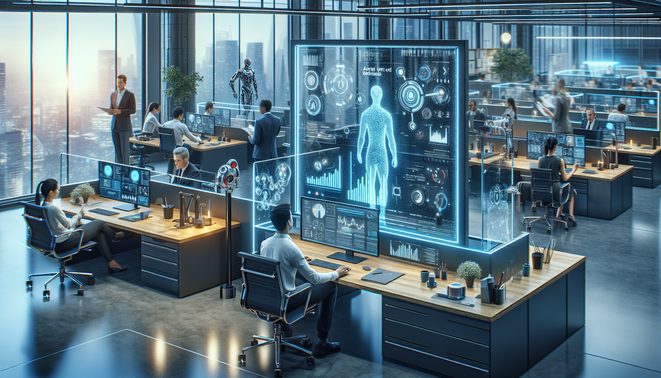
Imagine walking into your office five years from now. Your AI assistant has already drafted responses to overnight emails, analyzed last quarter’s performance data, and flagged three anomalies that need your attention. Your calendar suggests declining two meetings that could be handled asynchronously, freeing you for strategic work. This isn’t science fiction—it’s already happening in leading organizations worldwide.
We’re witnessing the most significant workplace transformation since the Industrial Revolution, but the narrative of mass unemployment misses the point entirely. Recent analyses show that while 80% of workers will see at least 10% of their tasks affected by AI, this exposure doesn’t translate to elimination. Instead, we’re entering an era of radical job transformation where success depends not on competing with AI, but on partnering with it effectively.
The question isn’t whether your job will exist in 2030. It’s whether you’re preparing for what that job will become.
The Intelligence Layer Reshaping Every Industry
Today’s enterprise AI systems have crossed a critical threshold. They’re no longer glorified calculators or simple automation tools—they’re capable of sophisticated reasoning, creative output, and complex decision support across domains that were exclusively human territory just months ago.
Financial services firms are deploying AI that analyzes risk portfolios with nuance that previously required years of experience. Legal departments use systems that review thousands of contracts in hours, identifying problematic clauses human eyes might miss after days of work. Healthcare organizations employ AI diagnostic assistants that detect patterns across millions of cases, augmenting physician expertise rather than replacing it.
The economic implications are staggering. Goldman Sachs research suggests AI could expose the equivalent of 300 million full-time positions globally to some form of automation or augmentation. Two-thirds of U.S. occupations will feel this impact. Yet the same analysis projects AI could boost global GDP by 7% over the next decade—a productivity surge that historically creates more opportunities than it destroys.
What’s different this time is speed and scope. Manufacturing automation unfolded over decades and primarily affected physical labor. AI is transforming knowledge work at an unprecedented pace, touching everyone from junior analysts to senior executives simultaneously. The office worker and the creative professional face the same imperative: adapt or become obsolete.
The Job Market Nobody Expected
Here’s where conventional wisdom about technological unemployment falls apart. We’re not seeing wholesale job elimination—we’re seeing wholesale job evolution.
Consider the radiologist. Predictions claimed AI would eliminate this profession within years. Instead, radiologists using AI-assisted diagnostic tools are more productive and accurate than ever. The job transformed: less time on routine scan review, more time on complex cases, patient consultation, and intervention planning. As MIT economist David Autor observes, “concerns about displacement are often overblown.”
Software developers offer another instructive example. AI can now generate functional code from natural language descriptions. Rather than eliminating programming jobs, this shift is pushing developers upstream—from code writers to system architects, from syntax debugging to strategic problem-solving. The mundane work gets automated; the creative and complex work expands.
The pattern repeats across industries. Financial analysts spend less time building spreadsheets and more time interpreting insights and advising clients. Journalists use AI to draft routine earnings reports while focusing their energy on investigative work that requires human judgment and source cultivation. Teachers leverage AI tutoring platforms to personalize learning while dedicating more attention to mentorship and socio-emotional development.
This transformation is creating an entirely new job category: human-AI collaboration specialists. Prompt engineers who know how to extract maximum value from AI systems. AI ethics officers ensuring responsible deployment. Algorithmic auditors checking for bias and errors. These roles didn’t exist three years ago; now they’re among the fastest-growing positions across sectors.
The World Economic Forum projects 69 million new jobs created against 83 million displaced over the next five years—a net decline of 14 million positions. But this aggregate masks significant variation. Entry-level data entry, basic bookkeeping, and routine customer service face genuine displacement risk. Meanwhile, roles requiring complex problem-solving, emotional intelligence, and creative thinking are expanding rapidly.
The uncomfortable truth? Your job title might remain the same while the actual work becomes unrecognizable. Every role is being unbundled into tasks, and those tasks are being reassigned between humans and machines based on comparative advantage.
The New Essential Skills: What Actually Matters
If you’re wondering what skills will keep you relevant as AI reshapes the workplace, the answer isn’t what most people expect.
Yes, technical fluency matters. Understanding how AI systems work, their capabilities and limitations, is becoming as fundamental as email literacy. Prompt engineering—the art of communicating effectively with AI systems to extract useful outputs—is evolving into a core workplace competency. Data interpretation skills allow you to make sense of AI-generated insights and catch errors that automated systems miss.
But here’s the paradox: as machines get better at technical tasks, distinctly human capabilities become exponentially more valuable.
Emotional intelligence tops the list. AI can analyze sentiment in customer communications, but it cannot feel empathy or build genuine human connection. The ability to understand, motivate, and collaborate with other humans becomes a premium skill in AI-augmented organizations.
Complex problem-solving—the non-routine kind that requires creativity and context—remains firmly in human territory. AI excels at optimization within defined parameters but struggles with ambiguity, novel situations, and problems that require reframing the question itself.
Ethical reasoning and judgment in nuanced situations represent another uniquely human domain. When should an AI recommendation be overridden? How do we balance competing values and stakeholder interests? These questions require the kind of moral reasoning that can’t be automated away.
Adaptability might be the ultimate meta-skill. The half-life of technical skills is shrinking from years to months in some fields. Learning agility—the capacity to quickly acquire new competencies and adjust to evolving tools and processes—determines who thrives versus who struggles through this transition.
Educational pathways are being completely reimagined. The four-year degree followed by 40 years of static knowledge is dead. The emerging model involves continuous micro-credentialing, just-in-time learning, and expecting 3-5 significant career transformations over a working lifetime. As one tech executive put it, “every job will be different.”
This doesn’t mean everyone needs to become an AI engineer. It means everyone needs to become an effective AI collaborator in their domain, combining technical augmentation with irreplaceable human judgment.
Navigating the Transformation: A Realistic Path Forward
The AI workplace transformation is neither utopian nor dystopian—it’s complex, uneven, and still being shaped by choices we make today.
For individual workers, the path forward requires honest self-assessment. Which of your current tasks could be automated or augmented? Where does your work require uniquely human capabilities? The goal isn’t to protect every existing task but to evolve toward higher-value contributions. Start experimenting with AI tools in your current role. Develop fluency with the technology that will reshape your profession. Invest in skills that complement rather than compete with machine capabilities.
For business leaders, the imperative extends beyond implementing AI to reimagining work itself. The companies succeeding in this transition aren’t simply automating existing processes—they’re fundamentally rethinking workflows to optimize human-AI collaboration. This requires investment in reskilling, redesign of roles and incentives, and honest dialogue with workers about how their jobs will evolve.
For policymakers and educators, the challenge is creating support structures for continuous workforce adaptation. This includes accessible retraining programs, safety nets for workers in transition, and educational reform that prioritizes learning agility over static knowledge acquisition.
The emerging research consensus suggests we’re entering a period of significant economic gains from AI—but whether those gains are broadly shared or narrowly concentrated depends entirely on intentional choices about deployment, regulation, and workforce investment.
What’s certain is this: the jobs of 2030 will look dramatically different from today’s roles. Some will disappear. Many will transform beyond recognition. Entirely new categories will emerge that we can’t yet imagine. The workers who thrive will be those who embrace this reality with clear eyes, develop genuinely valuable human capabilities, and learn to dance with intelligent machines rather than compete against them.
The great restructuring is underway. Your job won’t disappear—but standing still is no longer an option.