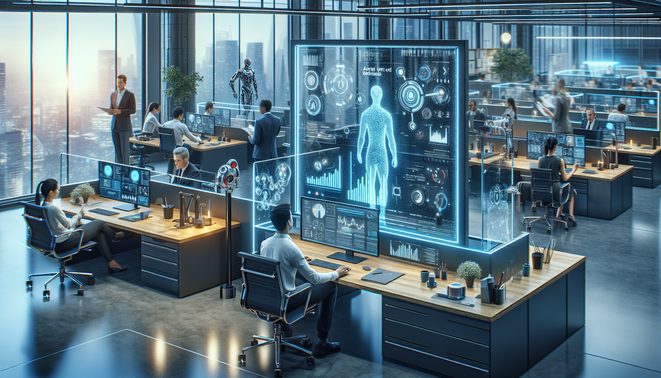
Imagine waking up to headlines proclaiming that half of all jobs will vanish within five years, replaced by artificial intelligence that works faster, cheaper, and without complaint. It’s a narrative that’s dominated tech discourse for years, fueling anxiety among workers and spawning countless “AI doomer” articles predicting economic catastrophe. But here’s the uncomfortable truth for pessimists: the mass unemployment apocalypse isn’t materializing the way they predicted.
Companies like DoorDash are showing us a different story—one where AI doesn’t simply replace humans but fundamentally reshapes how work gets done. The real transformation underway isn’t about eliminating jobs wholesale; it’s about reconfiguring what jobs look like, which skills matter, and how humans and machines collaborate. Understanding this shift isn’t just academically interesting—it’s essential for anyone who wants to remain relevant in the workforce over the next decade.
The Augmentation Revolution We’re Actually Living Through
Let’s get specific about what enterprise AI actually does today. At companies like DoorDash, AI systems optimize delivery routes in real-time, predict demand spikes before they happen, match drivers with orders using sophisticated algorithms, and detect fraudulent transactions in milliseconds. These aren’t hypothetical capabilities—they’re operational realities processing millions of transactions daily.
But here’s what’s not happening: DoorDash hasn’t eliminated its workforce. Instead, the company has transformed how those workers operate. Drivers receive better route suggestions, reducing wasted time and fuel. Restaurant partners get more accurate demand forecasts, minimizing food waste. Customer service representatives handle fewer routine queries because AI chatbots resolve simple issues, allowing humans to focus on complex problems that require empathy and judgment.
This pattern repeats across industries. In healthcare, AI assists with diagnostic imaging, but radiologists now act as specialist interpreters who catch what algorithms miss. In finance, AI flags suspicious transactions, but human analysts investigate the nuances. In software development, AI generates boilerplate code, freeing developers to architect complex systems and solve novel problems.
The data supports this augmentation story. Research from McKinsey suggests that while 60% of occupations have at least 30% of tasks that could be automated, very few jobs are entirely automatable. The difference between automating tasks and eliminating jobs turns out to be enormous—and it’s the fundamental error that doomer predictions consistently make.
Jobs Aren’t Disappearing—They’re Metamorphosing
Walk into a modern delivery logistics operation, and you’ll find job titles that didn’t exist five years ago: AI operations specialists who monitor algorithmic performance, data quality analysts who ensure training datasets remain accurate, and algorithm auditors who check for bias and fairness issues. These aren’t fringe positions—they’re core operational roles.
The economist Daron Acemoglu frames this choice clearly: “AI can be deployed in ways that augment workers’ abilities or replace them.” What we’re seeing is that augmentation often makes better business sense than wholesale replacement. Why? Because implementing AI is expensive, organizational change is difficult, and customers frequently prefer human interaction for anything beyond routine transactions.
Consider how specific roles are evolving rather than vanishing. Customer service representatives aren’t becoming obsolete—they’re becoming complex issue specialists. AI handles “Where’s my order?” inquiries, while humans manage upset customers, navigate unusual situations, and build relationships that create loyalty. The job hasn’t disappeared; it’s been upgraded.
Delivery drivers at companies like DoorDash aren’t facing immediate replacement by autonomous vehicles—that technology remains years away from widespread deployment. Instead, they’re becoming fleet optimization partners who use AI recommendations while applying local knowledge that algorithms can’t replicate. They know which apartment building has the broken buzzer, which restaurant always runs ten minutes late, and how to navigate construction that hasn’t made it into mapping systems yet.
Software engineers provide perhaps the clearest example of transformation. AI coding assistants now generate functions, suggest completions, and identify bugs. Rather than eliminating programming jobs, this has shifted the role toward higher-level thinking: system architecture, user experience design, and solving problems that require genuine creativity. As Andrew Ng observes, “Just as electricity transformed industries over decades, not overnight, AI transformation will be gradual.”
The jobs being created often surprise us. Prompt engineers—people skilled at communicating effectively with AI systems—command six-figure salaries. Human-AI collaboration designers study how to optimize workflows that blend algorithmic and human intelligence. Ethics officers ensure responsible AI deployment. These roles didn’t exist in most organizations three years ago; now they’re rapidly growing job categories.
The Skills That Will Keep You Employed
If jobs are transforming rather than disappearing, the urgent question becomes: which skills matter in an AI-augmented workplace?
The technical skills gaining value aren’t necessarily advanced programming (though that helps). Instead, AI literacy—understanding what these systems can and cannot do—has become foundational. Workers who can effectively use AI tools, interpret their outputs critically, and know when to override algorithmic suggestions become dramatically more productive than those who can’t.
Data interpretation skills now matter across roles that never previously required them. Restaurant managers at DoorDash partner locations need to understand demand forecasts. Customer service specialists need to recognize patterns in AI escalations. Marketing professionals need to evaluate AI-generated insights about customer behavior. The ability to make sense of data-driven recommendations has shifted from specialized analyst work to general professional competency.
But here’s the paradox: as AI handles more analytical and routine cognitive work, uniquely human capabilities become more valuable, not less. Emotional intelligence—reading customer frustration, building team trust, navigating office politics—can’t be algorithmed away. Complex problem-solving in novel situations remains stubbornly human. Creative thinking that generates genuinely original ideas rather than recombining existing patterns still requires human insight.
The workers thriving in AI-augmented environments share a critical trait: adaptability. They view new AI tools as capabilities to master rather than threats to fear. They’re comfortable with continuous learning, recognizing that the specific tools will keep evolving but the meta-skill of learning new systems remains constant.
Educational pathways are adapting, though not fast enough. Forward-thinking programs now combine technical foundations with uniquely human skills—liberal arts plus coding, business strategy plus data science, healthcare plus AI ethics. Micro-credentials and specific tool certifications allow workers to continuously update capabilities without returning to full-time education. Apprenticeship models that teach human-AI collaboration on the job are expanding.
The uncomfortable truth is that succeeding in the AI era requires embracing lifelong learning as a permanent career feature, not a phase. The days of front-loading education in your twenties and coasting on that knowledge for forty years are definitively over.
Navigating the Transition Ahead
So where does this leave us? The AI doomers were wrong about the timeline and mechanism, but they weren’t entirely wrong about disruption. Significant workforce transition is underway—it’s just more complex and gradual than the apocalyptic predictions suggested.
For individual workers, the path forward requires proactive adaptation. Start developing AI literacy now, even if your current role doesn’t require it. Identify which aspects of your job involve genuine human judgment, relationship-building, or creative problem-solving, and lean into those capabilities. Seek opportunities to work alongside AI systems rather than in competition with them. Most importantly, cultivate adaptability itself as a core competency.
For employers, the choice Acemoglu identifies—augmentation versus replacement—carries profound consequences. Companies that use AI to make workers more capable create better customer experiences, retain institutional knowledge, and maintain flexibility that fully automated systems lack. The short-term cost savings of replacement often prove illusory when implementation costs, quality issues, and customer pushback materialize.
For policymakers, the challenge involves smoothing transitions without stopping progress. That means education systems adapted for continuous learning, safety nets that support workers between roles, and incentives for responsible AI deployment that augments rather than simply displaces.
The DoorDash example illuminates a broader pattern: companies gaining competitive advantages from AI are typically enhancing human capabilities rather than eliminating them. They’re creating new roles, transforming existing ones, and finding that the hybrid human-AI approach often outperforms either alone.
The future of work won’t be jobless—but it will be different. The workers who thrive will be those who embrace that difference, continuously adapt, and focus on capabilities that complement rather than compete with artificial intelligence. The doomers predicted catastrophe, but what’s actually emerging is something more nuanced: a workforce transformation that’s challenging, disruptive, and ultimately navigable for those willing to evolve alongside the technology.