The AI Infrastructure Boom: Your Job in 2027 and Beyond
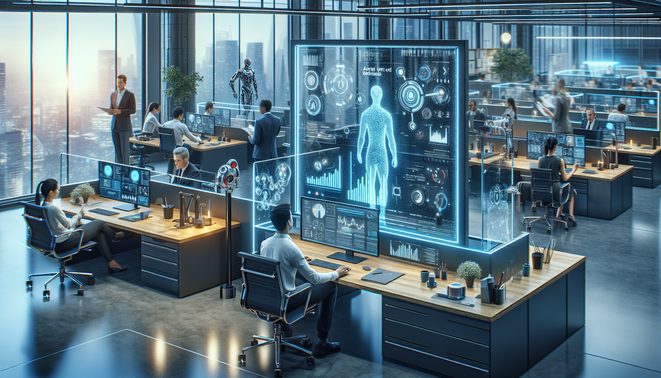
Imagine walking into your office in 2027. Your AI assistant has already prioritized your emails, drafted three client proposals, and identified the two meetings you actually need to attend. Meanwhile, the department that once employed twelve people now runs with five—each earning significantly more than before, but doing work that barely resembles their old job descriptions. This isn’t science fiction. It’s the reality unfolding right now as companies forge partnerships with AI infrastructure giants like Nvidia, fundamentally rewiring how work gets done.
The numbers tell a stark story: while AI could contribute up to $4.4 trillion annually to the global economy, the World Economic Forum projects a net loss of 14 million jobs by 2027. But this headline obscures a more nuanced truth—we’re not simply losing jobs, we’re witnessing the most rapid occupational transformation in human history. The question isn’t whether your job will be affected. It’s how you’ll adapt to a workplace where artificial intelligence isn’t a tool you use occasionally, but a colleague you work alongside constantly.
The Infrastructure Revolution You Can’t See
Most people imagine AI as chatbots or self-driving cars, but the real revolution is happening in the invisible infrastructure layer. Companies are deploying GPU-accelerated computing systems that can process in minutes what once took analysts weeks. These aren’t incremental improvements—they’re fundamental rewrites of organizational capability.
The financial services sector offers a preview of what’s coming everywhere else. Banks deploying advanced AI infrastructure are automating up to 70% of back-office operations, from fraud detection to risk assessment. One major investment firm now handles three times the trading volume with 40% fewer analysts. The analysts who remain? They’re not crunching numbers—they’re interpreting AI-generated insights and managing client relationships, roles that require completely different skill sets than traditional quantitative analysis.
Healthcare is experiencing a parallel transformation. AI-powered diagnostic systems trained on millions of medical images can detect anomalies with accuracy that exceeds individual radiologists. But rather than eliminating radiologists, forward-thinking hospitals are repositioning them as diagnostic specialists who handle complex cases and patient communication while AI handles routine screenings. Early data shows this hybrid approach increases diagnostic accuracy by 30% while allowing each radiologist to serve more patients.
Manufacturing facilities partnering with AI infrastructure providers are discovering they need fewer workers overall, but those workers require exponentially more sophisticated capabilities. A modern smart factory might employ one AI operations engineer where it previously employed five maintenance technicians. That engineer might earn twice what the technicians made, but that’s cold comfort to the four people whose roles vanished.
The Great Reconfiguration: What Happens to Your Job
The emerging employment picture defies simple narratives about robots taking everyone’s jobs. Instead, we’re seeing three distinct categories: jobs being created, jobs being transformed beyond recognition, and jobs being displaced entirely.
Creation is happening fastest at the technical frontier. Companies are desperately hiring AI infrastructure engineers, MLOps specialists, and AI ethics officers—roles that barely existed three years ago. A prompt engineer who optimizes how humans interact with AI systems can command $180,000 straight out of a coding bootcamp. Synthetic data engineers who create artificial training datasets are even more valuable, with salaries reaching $210,000. The problem? These positions might total 15 million globally by 2027, while displacement could affect ten times that number.
Transformation is where things get interesting and uncomfortable. Consider software developers, perhaps the profession that seemed most immune to automation. With AI coding assistants, developers are becoming 40% more productive—which sounds wonderful until you realize it means companies need 30% fewer developers overall. The role is evolving from writing code to architecting systems and reviewing AI-generated code. Developers who can make this leap are thriving. Those who can’t are struggling to compete with both AI and their augmented peers.
The pattern repeats across industries. Graphic designers are becoming creative directors who guide AI tools rather than pushing pixels themselves. Financial advisors are shifting from portfolio management to life planning as algorithms handle optimization. One Harvard Business Review analysis captures it perfectly: “Organizations need fewer people overall, but exponentially more sophisticated skill sets.” This isn’t just upskilling—it’s occupational metamorphosis.
Displacement, meanwhile, is hitting hardest in administrative, clerical, and routine cognitive work. Data entry clerks, basic customer service representatives, bookkeeping clerks—roles that once provided stable middle-class employment are being automated at scale. The MIT Technology Review notes that “for every AI infrastructure job created, four to five traditional IT roles disappear.” Even more troubling, many displaced workers are in their 40s and 50s, precisely the demographic that faces the steepest reskilling challenges.
The emerging reality is a barbell-shaped job market: high-skilled, high-wage positions working with AI on one end, and jobs requiring irreducibly human skills like caregiving and skilled trades on the other. The middle—routine cognitive work that provided economic security for generations—is hollowing out fast.
The New Essential Skills
If you’re reading this wondering what to learn, the answer is more nuanced than “learn to code” (though that doesn’t hurt). The most valuable professionals in 2027 won’t be those with the deepest AI expertise—those roles are relatively few. Instead, value will come from combining AI literacy with domain expertise and distinctly human capabilities.
On the technical side, you don’t need a PhD in machine learning, but you do need genuine AI fluency. This means understanding how AI systems work, what they can and cannot do, and how to evaluate their outputs critically. Think of it as the new baseline literacy—comparable to computer skills in the 1990s. Beyond that, familiarity with data fundamentals, cloud computing basics, and at least one programming language creates optionality across industries.
But here’s what’s surprising: as AI handles more analytical heavy lifting, distinctly human skills are becoming premium commodities. Emotional intelligence, creative problem-solving, and ethical judgment—capabilities AI can’t replicate—are moving from “nice to have” to essential. Stanford researchers found that roles requiring high emotional intelligence are among the least automatable and are seeing wage growth even as technically similar roles decline.
Perhaps most critical is what Satya Nadella describes as the ability to learn itself: “Technical skills have a half-life of 2-3 years now.” The professionals thriving in this transition aren’t necessarily the most technically skilled—they’re the most adaptable, those who view reskilling as a permanent condition rather than a one-time event.
For practical preparation, the most effective pathway combines three elements: First, develop baseline AI literacy through focused online courses or bootcamps. Second, deepen your expertise in a domain where AI needs human judgment—healthcare, complex B2B sales, creative strategy, anything requiring contextual understanding. Third, cultivate one or two irreducibly human skills that AI can’t touch: leadership, coaching, negotiation, or creative innovation.
Navigating the Transition
We stand at an inflection point. The AI infrastructure being deployed today will reshape employment for decades. The World Economic Forum warns that “workers have limited time to reskill for roles that don’t yet fully exist,” which captures both the urgency and the difficulty of this moment.
For individuals, the path forward requires honest assessment and proactive adaptation. If your role involves primarily routine cognitive work—data processing, document review, basic analysis—the time to reskill is now, not later. Seek roles where you’re working alongside AI rather than competing with it. Look for positions requiring contextual judgment, relationship building, or creative synthesis.
For employers, the responsibility extends beyond quarterly results. Companies successfully navigating this transition are investing heavily in reskilling their existing workforce rather than simply hiring new talent. The most effective programs combine technical training with reimagined roles that leverage both AI capabilities and human judgment.
For policymakers, the challenge is creating infrastructure for mass reskilling while providing support for those who can’t transition. The current trajectory, as MIT economist Daron Acemoglu warns, risks highly unequal outcomes without deliberate intervention.
The future of work isn’t predetermined. Yes, AI infrastructure partnerships are accelerating automation and transformation. Yes, significant displacement is inevitable. But the ultimate outcome depends on choices we make today—as individuals investing in our skills, as companies deploying these technologies, and as societies deciding what kind of transition we want to create. The jobs of 2027 will look radically different than today’s. The question is whether we’ll build pathways allowing people to reach them, or watch inequality accelerate as opportunity concentrates among those already positioned to thrive.
The infrastructure is being built right now. Your move.