Imagine waking up to find that Wall Street has created an investment index specifically for companies that don’t use artificial intelligence. It sounds counterintuitive in our tech-obsessed world, yet this scenario reflects a profound truth: we’re not heading toward a single AI-powered future, but rather toward two parallel economies. One will leverage artificial intelligence to maximize productivity and efficiency. The other will double down on irreplaceable human capabilities. The question facing millions of workers isn’t whether AI will change their jobs—it’s which side of this divide they’ll land on, and whether they’re preparing for either possibility.
The Transformation Nobody Saw Coming
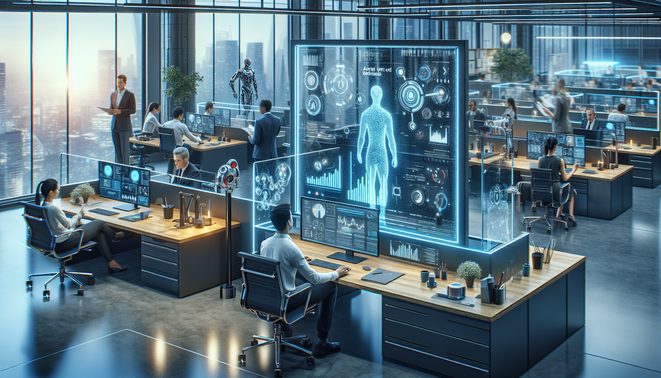
The enterprise AI revolution isn’t unfolding the way most experts predicted. Rather than a wholesale replacement of human workers with robots and algorithms, we’re witnessing something more nuanced: a fundamental reconfiguration of what humans do at work. Advanced AI systems can now draft legal documents, analyze medical imagery, write marketing copy, and generate code—tasks that once required years of specialized training.
The shift is happening fastest in knowledge work sectors. Financial services firms use AI to process transactions that once required teams of analysts. Healthcare organizations deploy machine learning to triage patients and predict treatment outcomes. Manufacturing facilities integrate intelligent systems that don’t just follow instructions but optimize entire production processes in real-time. Research suggests these technologies could affect hundreds of millions of jobs globally, though the impact varies dramatically by industry and role.
What’s striking isn’t just the breadth of AI capabilities, but the speed of adoption. Companies that hesitated to embrace cloud computing for years are now racing to integrate generative AI into core business processes. This velocity creates a compression of the traditional technology adoption curve, leaving workers less time to adapt than previous industrial transitions allowed. The workers who thrived during past technological shifts had decades to retrain. Today’s workforce may have less than half that time.
The Job Market Nobody Prepared For
Here’s where the story gets complicated: AI is simultaneously destroying jobs, creating entirely new roles, and transforming existing positions beyond recognition. A customer service representative whose role gets automated isn’t simply unemployed—they’re potentially freed to handle complex customer issues that require empathy and creative problem-solving, while AI handles routine inquiries. But that transition requires new skills, and there’s no guarantee the same number of human workers will be needed.
The jobs emerging in AI’s wake fall into distinct categories. First, there are technical roles: prompt engineers who know how to communicate with AI systems, AI ethicists who ensure responsible deployment, and integration specialists who connect artificial and human intelligence within workflows. These positions command premium salaries but require technical fluency many workers lack.
Second, we’re seeing explosive growth in roles that emphasize distinctly human capabilities. As one technology economist noted, artificial intelligence is pushing us to recognize that some work is valuable precisely because humans do it. Therapists, executive coaches, artisan craftspeople, and creative directors aren’t just surviving the AI revolution—many are thriving as organizations realize that human judgment, emotional intelligence, and original creativity remain irreplaceable.
The automation versus augmentation debate captures this tension perfectly. Some industries are using AI to eliminate positions entirely, pursuing efficiency gains and cost reduction. Others are deploying the same technologies to enhance human capabilities, allowing workers to be more productive and focus on higher-value activities. The difference often comes down to management philosophy rather than technical capability. Companies choosing augmentation tend to maintain or even increase headcount while boosting productivity. Those pursuing pure automation see workforce reductions but face challenges with innovation, customer satisfaction, and organizational resilience.
Perhaps most significantly, we’re witnessing the emergence of what economists call a bifurcated labor market. One tier consists of high-skill workers who leverage AI tools to multiply their productivity and command increasing compensation. Another includes workers whose roles are either eliminated or deskilled by automation, facing wage stagnation or displacement. The middle tier—routine cognitive work that once provided stable middle-class employment—is being hollowed out, a phenomenon that carries profound implications for economic inequality and social stability.
The Skills That Will Matter Tomorrow
If you’re wondering how to position yourself for this bifurcated future, the answer is surprisingly straightforward, though not necessarily easy: develop skills that are either highly complementary to AI or nearly impossible for machines to replicate.
On the technical side, AI literacy is becoming as fundamental as computer literacy was two decades ago. This doesn’t mean everyone needs to become a data scientist. It means understanding what AI can and cannot do, how to evaluate AI-generated outputs, and how to integrate these tools into your workflow effectively. Workers who can operate at the intersection of domain expertise and AI capability—the accountant who knows which financial analyses to automate, the marketer who understands how to direct AI creative tools—will be invaluable.
Yet the most enduring competitive advantage may lie in distinctly human capabilities that machines struggle to match. Complex problem-solving in ambiguous situations. Emotional intelligence and the ability to build genuine relationships. Creative thinking that makes unexpected connections. Physical skills requiring adaptability and dexterity. Strategic judgment that weighs competing values and long-term consequences.
Educational institutions are scrambling to catch up, but workers cannot wait for formal systems to adapt. The most successful professionals are already building hybrid skill sets through online courses, professional certifications, apprenticeships, and hands-on experimentation. The key is developing what economists call a “skills portfolio”—a diverse collection of capabilities spanning technical proficiency, domain expertise, and human-centric abilities that makes you valuable across multiple scenarios.
This also means embracing continuous learning as a permanent career requirement rather than a temporary phase. The half-life of technical skills is shrinking rapidly. What you learn today may be partially obsolete in three years and largely irrelevant in five. Building the habit of constant skill acquisition and the confidence to learn new domains quickly may be more valuable than any specific expertise.
Navigating the Great Divide
So where does this leave us? The emergence of AI-resistant business models and investment strategies signals that the future of work won’t be monolithic. There will be thriving careers in AI-integrated companies, sustainable employment in human-centric organizations, and countless hybrid roles that blend both approaches.
For workers, this demands strategic thinking about career positioning. Assess your current role’s vulnerability to automation honestly, without denial or panic. Develop at least one skill that machines cannot easily replicate while building enough AI literacy to remain relevant in increasingly digital workplaces. Consider portfolio careers that diversify your income and experience across different types of work. Most importantly, cultivate adaptability—the meta-skill that allows you to navigate whichever future actually unfolds.
For employers, the moment demands choices about organizational values and competitive strategy. Pure automation may deliver short-term cost savings but sacrifice innovation capacity and customer relationships. Thoughtful augmentation requires investment in training and workflow redesign but can deliver sustainable advantages in quality and resilience.
For policymakers and educational institutions, the urgency cannot be overstated. Workforce transitions of this magnitude don’t happen smoothly without deliberate support systems: retraining programs, portable benefits, educational access, and social safety nets that help displaced workers bridge to new opportunities.
The “great divide” in tomorrow’s job market isn’t predetermined. It’s being shaped right now by millions of individual decisions from workers, companies, and institutions. Those who recognize that AI creates divergent paths rather than a single inevitable future—and who prepare accordingly—will be best positioned not just to survive the transformation, but to thrive within it. The future of work won’t look the same for everyone, and perhaps that’s exactly the point.