When AI Stops Waiting: The Rise of Autonomous Agents at Work
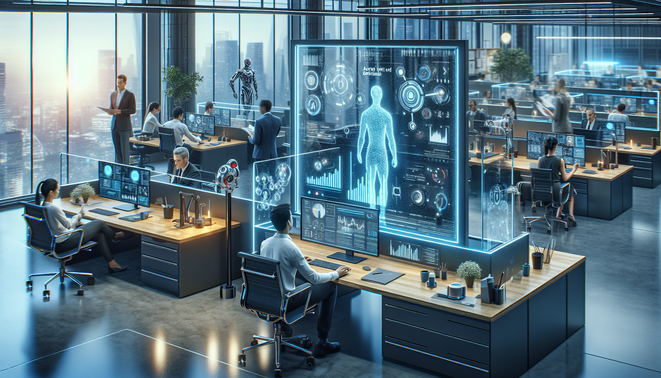
Imagine arriving at your office to discover that your AI assistant has already rescheduled your conflicting meetings, drafted responses to urgent emails, compiled the research for your afternoon presentation, and flagged three strategic opportunities buried in overnight market data—all before you’ve poured your first coffee. This isn’t science fiction. It’s the emerging reality of autonomous AI agents that don’t wait for commands but anticipate, decide, and act independently.
We’re witnessing a fundamental shift in artificial intelligence: from tools we actively use to agents that proactively work alongside us. Investment in autonomous AI systems reached $47 billion in 2025, and projections suggest these systems will handle 30-40% of knowledge worker tasks by 2028. This transformation raises an urgent question for every professional: not whether AI will change your job, but how quickly you can adapt to working with an intelligence that never sleeps.
The Transformation Underway
The AI systems entering workplaces today operate fundamentally differently than their predecessors. While ChatGPT and similar tools wait for your prompt, autonomous AI agents monitor your calendar, email, project deadlines, and business context continuously—then take action within defined parameters without asking permission.
This evolution is powered by converging technologies: advanced language models with enhanced reasoning, ambient computing that embeds intelligence throughout work environments, and persistent context awareness that allows AI to understand not just individual requests but entire workflows. The result is what some are calling “ambient intelligence”—technology that fades into the background while actively managing complexity.
Professional services are experiencing this shift first. In accounting firms, autonomous agents now handle routine auditing procedures, flagging anomalies for human review. Legal research that once consumed junior associates’ entire days now happens overnight, with AI agents synthesizing case law and identifying relevant precedents. Consulting firms report that preliminary analysis—gathering data, identifying patterns, creating initial frameworks—increasingly happens before human consultants even join the conversation.
Customer service represents perhaps the most visible transformation. Goldman Sachs estimates that 300 million jobs globally will be affected by this wave of automation, with customer support roles facing 85% automation rates for routine inquiries by 2027. The call centers aren’t going silent; they’re being fundamentally reimagined around the complex, emotional, and high-stakes interactions where human judgment remains irreplaceable.
Financial services, healthcare administration, and supply chain management are seeing similar patterns: AI agents autonomously optimizing what humans once coordinated manually. Seventy-three percent of Fortune 500 companies are already piloting these systems, racing to capture efficiency gains that early adopters report can reach 2-3x productivity improvements.
The Job Market Reconfiguration
The conversation around AI and employment often gets stuck in a false binary: will AI create or destroy jobs? The reality emerging is more nuanced and more complex.
Certain roles face genuine displacement risk. Administrative positions involving data entry, scheduling, and routine coordination—roles employing millions globally—show 60-80% automation potential. Junior analysts across finance, consulting, and research face 50-70% automation of their current responsibilities. Even middle management roles focused on routine coordination and oversight are seeing 40-60% of their functions absorbed by autonomous systems that never sleep and never lose track of details.
Yet the story isn’t simply subtraction. As Dr. Fei-Fei Li from Stanford’s AI Lab observes, “The workers who thrive will be those who ask better questions, not find better answers.” This insight captures the transformation underway: roles aren’t disappearing so much as being radically redefined.
Consider the customer service representative becoming a customer experience designer—no longer answering the same questions repeatedly but designing the AI interaction flows and handling the complex cases that require empathy and creative problem-solving. Or the financial analyst evolving into an AI-augmented strategic advisor, freed from data gathering to focus entirely on interpretation and strategic recommendations that drive business decisions.
Project managers are becoming AI orchestration managers, coordinating not just human teams but hybrid workforces where AI agents handle routine coordination while humans focus on stakeholder relationships, strategic pivots, and navigating ambiguity. Software developers increasingly act as AI solution architects, designing systems that leverage autonomous agents rather than writing every line of code themselves.
Entirely new categories of work are emerging rapidly. AI agent trainers and supervisors—professionals who monitor autonomous systems, handle exceptions, and provide feedback to improve performance—could number 500,000 positions by 2028. AI ethics and governance officers are growing 400% annually as organizations realize autonomous decision-making requires sophisticated oversight. Human-AI interaction designers, combining expertise in psychology, user experience, and AI systems, command median salaries of $145,000 as companies scramble to create seamless collaboration between human and artificial intelligence.
The debate isn’t whether these new roles will exist—they already do—but whether they’ll emerge fast enough and in sufficient numbers to absorb workers displaced from traditional roles. As MIT economist Daron Acemoglu notes, “We’re not replacing humans—we’re fundamentally redefining human work.” The question is whether that redefinition creates broadly shared opportunity or concentrates gains among those already positioned to adapt.
Skills for the AI Era
If AI agents are handling routine analysis, data processing, and coordination, what skills become valuable for human workers? The answer combines technical fluency with distinctly human capabilities.
On the technical side, AI literacy has become as fundamental as digital literacy was two decades ago. This doesn’t mean everyone needs to code AI systems, but professionals increasingly need to understand what AI can and cannot do, how to effectively direct autonomous agents, and how to validate AI outputs. Prompt engineering—the ability to communicate goals and constraints effectively to AI systems—is evolving from a niche specialty to a core workplace skill.
Data interpretation matters more than data gathering. When AI can assemble information instantly, the human value lies in asking whether the right question was asked in the first place, identifying what the data doesn’t show, and recognizing patterns that fall outside AI training parameters.
Yet the skills seeing the most dramatic appreciation are those AI cannot easily replicate. Critical thinking and judgment in ambiguous situations. Creative problem-solving for challenges that don’t match existing patterns. Emotional intelligence for navigating complex human dynamics. Strategic thinking that sets direction rather than executes tasks. Ethical reasoning when algorithms offer efficiency but raise moral questions.
As Microsoft CEO Satya Nadella observes, we’re experiencing “the biggest workforce transformation since the Industrial Revolution, condensed into 5-7 years.” That compression creates urgency around reskilling.
Educational institutions are scrambling to adapt. Universities are launching AI-augmented programs across disciplines—AI-augmented business, law, medicine—recognizing that every field must now integrate autonomous intelligence. Community colleges are creating AI technician certification programs, targeting the operational roles that will maintain and optimize these systems. Micro-credentials and skill-specific certificates are proliferating as traditional four-year degrees struggle to keep pace with technological change.
Corporations are stepping into the gap with massive reskilling initiatives. Amazon’s commitment to retrain 100,000 workers for AI-adjacent roles signals that companies recognize they must build the talent pipeline they need. The most successful organizations are creating internal AI academies, treating continuous learning not as HR programming but as core business strategy.
The uncomfortable truth is that the average worker may need to significantly reskill three to four times over their career. The single most valuable skill may be learning itself—the capacity and willingness to continuously acquire new capabilities as technology evolves.
The Path Forward
Standing at this inflection point, the range of possible futures is unusually wide. As Max Tegmark from MIT’s Future of Life Institute puts it, “If we get this right, unprecedented productivity and human flourishing. If we get it wrong, mass unemployment and social instability.”
For individual workers, passivity is the highest-risk strategy. Actively developing AI literacy, cultivating skills that complement rather than compete with AI, and maintaining learning agility create resilience regardless of how quickly autonomous agents spread through your industry. Seek roles where you’re directing AI rather than competing with it.
For employers, the companies that will dominate their industries are those viewing AI as a work redesign opportunity rather than a simple replacement tool. This means investing in reskilling, creating new roles that leverage uniquely human capabilities, and building cultures where humans and AI agents collaborate effectively. The data is clear: organizations that proactively redesign work around AI capabilities see dramatically better outcomes than those simply automating existing jobs.
For policymakers and educators, the challenge is building reskilling infrastructure at the scale and speed this transformation demands. Workers displaced at 45 need viable pathways to meaningful work, not platitudes about long-term job creation. Education systems need fundamental reimagining for a world where knowledge itself is increasingly commoditized.
The autonomous AI era is not approaching—it’s here. The question isn’t whether your work will change, but whether you’ll shape that change or be shaped by it. In a world where AI never sleeps, human judgment, creativity, and adaptability have never been more valuable. The future belongs to those who can ask the questions AI alone cannot answer.