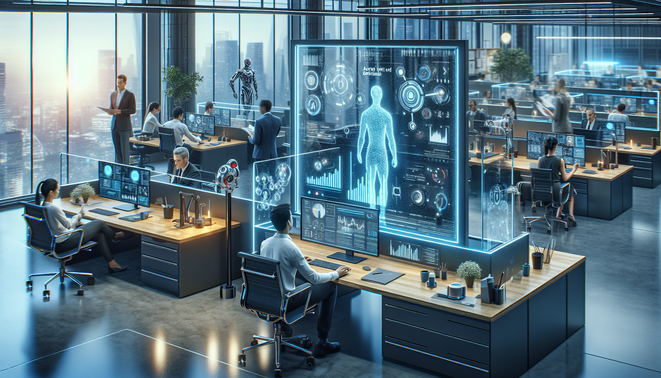
A 26-year-old software developer in Kyiv sits in a makeshift office, laptop open, writing code that will guide autonomous drones to their targets. She learned machine learning through online courses just eighteen months ago. Today, her algorithms are deployed in active combat zones, part of Ukraine’s rapidly expanding arsenal of AI-powered weapons systems. This scene—replicated across hundreds of tech workshops and defense startups—offers a glimpse into a workforce transformation already underway, one that will reshape careers far beyond the battlefield.
The Ukraine-Russia conflict has become an unexpected catalyst for the future of work in the defense sector and beyond. What military planners expected to take a decade is happening in months. And the implications extend well past the defense industry, signaling a broader reconfiguration of how humans and artificial intelligence will share the workplace in the coming years.
The Fastest Learning Curve in Military History
Ukraine has deployed over 100 different drone manufacturers in combat operations, creating what industry observers call “Silicon Valley at war.” The results are staggering: AI-enabled target recognition accuracy has jumped from 60% to 95% during the conflict. Drones now navigate without GPS when signals are jammed, coordinate in swarms to overwhelm defenses, and identify military targets with minimal human oversight.
This technological leap isn’t happening in isolated research labs. It’s occurring in compressed development cycles where feedback from Tuesday’s combat mission informs Wednesday’s software update. As Dr. Paul Scharre of the Center for New American Security observed, this represents “the fastest real-world AI learning curve we’ve ever witnessed in military technology.”
The acceleration has triggered a global response. Thirty-two countries now maintain active military AI drone programs, up from just twelve in 2023. Defense contractors have increased their autonomous systems budgets by 40%, while smaller defense tech startups raised nearly $9 billion in 2025 alone—triple the previous year. The barrier to sophisticated weapons development has collapsed so dramatically that a team of ten engineers can now build systems that previously required thousands of workers and years of development.
This shift from hardware-intensive, decade-long defense programs to software-driven, rapid-iteration development marks a fundamental restructuring of the defense industry—and the workforce that powers it.
A Jobs Market Being Rewritten in Real Time
The transformation underway creates a complex picture of displacement, creation, and evolution across the employment landscape. The numbers tell a story of dramatic change: analysts project 250,000 new jobs in the defense AI sector by 2030, even as 200,000 to 300,000 traditional defense manufacturing positions face displacement.
The newly created roles didn’t exist five years ago. Autonomous systems AI engineers, commanding salaries between $150,000 and $300,000, design the algorithms that enable drones to recognize targets, navigate autonomously, and make split-second decisions. Adversarial AI specialists test these systems against AI-powered attacks, a field expected to employ 30,000 to 40,000 professionals globally. Combat data scientists analyze battlefield performance to continuously improve AI models, while military data annotators—a role requiring understanding of military equipment and tactical scenarios—label the training data that makes machine learning possible.
Perhaps most intriguing are the hybrid roles emerging at the intersection of traditional military expertise and cutting-edge technology. The U.S. Air Force created the “Digital Warfare Officer” position in 2025, recognizing that future conflicts require warriors who understand code as well as tactics. As one Air Force general put it, “In 10 years, we’ll have more people writing code for our weapons systems than flying them.”
But this isn’t simply a story of addition. Traditional defense manufacturing workers face an uncertain future as simpler, cheaper drones replace complex weapons systems. Assembly line workers who spent careers building missile components and aircraft parts find their skills increasingly obsolete. Entry-level aerospace engineers without software expertise struggle to compete with younger colleagues fluent in machine learning frameworks. Even military pilots are experiencing upheaval—not elimination, but a fundamental transformation of what their jobs entail and how many positions will exist.
The displacement follows a geographic pattern as well. New AI defense jobs concentrate in tech hubs like Seattle, Austin, and San Diego, while traditional defense manufacturing centers in the Midwest and South watch positions evaporate. This spatial reorganization creates winners and losers not just among individuals, but entire communities.
A defense industry recruiter captured the transition starkly: “We’re seeing mechanical engineers with 20 years of experience competing with 25-year-old ML engineers for the same positions, and losing.” Age and experience no longer guarantee employability when the fundamental nature of the work has shifted.
Skills for a World of Human-Machine Teams
The skills gap emerging from this transformation is sobering. Universities currently produce only 40% of the AI engineers the defense sector needs, while the cybersecurity shortage for AI systems exceeds 75,000 unfilled positions. But the skills challenge runs deeper than simply training more programmers.
Technical competencies form the foundation: machine learning frameworks, computer vision algorithms, edge AI optimization, and autonomous systems development top employer wish lists. Yet defense AI demands more than pure coding ability. Safety-critical software development, secure coding practices, and real-time embedded systems require specialized knowledge that most computer science programs don’t emphasize. Security clearances, lengthy to obtain, create another bottleneck in talent pipelines.
Increasingly, the most valuable workers bridge multiple domains. Ex-military personnel who learn software development command premium salaries because they understand both the tactical environment and the technology. Systems integration engineers who can connect AI with legacy military hardware remain in critically short supply. The industry needs what educators call “T-shaped” professionals: deep expertise in one area combined with working knowledge across several disciplines.
The soft skills taking on outsized importance might surprise those who imagine AI development as purely technical work. Ethical reasoning tops many employers’ requirements lists as companies grapple with the moral implications of autonomous weapons. Universities are developing “Ethics in Defense AI” courses in response. As MIT’s program directors note, “We need engineers who can code AND grapple with moral complexity.” Cross-cultural collaboration matters more as allied nations coordinate on AI defense systems. And perhaps most critically, rapid learning ability and adaptability trump static expertise when technology evolves so quickly that skills require refreshing every six to twelve months.
The mindset shift may be the most challenging transition of all. Defense traditionally meant building something once to last decades. AI defense requires continuous updates and rapid iteration—a fundamentally different approach to work. Success demands comfort with uncertainty, an agile mindset, and the ability to think in terms of human-AI teaming rather than humans or machines alone.
Educational institutions are scrambling to respond. Carnegie Mellon now offers a Master’s in Autonomous Systems. Georgia Tech focuses its Robotics program on defense applications. But alternative pathways are proliferating faster: coding bootcamps specifically for veterans, corporate training programs at major defense contractors, and apprenticeship models at startups that put learners into real projects immediately. The defense sector is discovering it cannot wait for traditional educational pipelines to catch up.
Navigating the Transformation Ahead
The convergence of AI and defense in Ukraine offers a preview of workforce transformations coming to other sectors. The patterns visible today—rapid displacement of routine work, creation of hybrid human-AI roles, premium value for those who bridge domains, critical importance of continuous learning—will play out across industries as AI capabilities mature.
For workers, the imperative is clear: develop technical literacy even if you’re not becoming an engineer, cultivate the distinctly human skills that complement AI, and embrace continuous learning as a permanent feature of professional life. For employers, the challenge involves creating pathways for existing workers to transition rather than simply replacing them, and building cultures that support rapid adaptation.
Policymakers face perhaps the thorniest challenges: supporting displaced workers and communities, ensuring educational institutions evolve at the pace technology demands, and grappling with the ethical frameworks needed for an age of autonomous systems.
The young developer in Kyiv writing drone algorithms represents not just Ukraine’s response to invasion, but a broader reshaping of work in the 21st century. Her rapid transition from online learner to combat AI developer—accelerated by necessity—suggests both the opportunities and disruptions ahead. The jobs of the future are being created today, in the most unexpected of classrooms: a war zone that has become the world’s most intensive laboratory for human-machine collaboration. The question isn’t whether this transformation will reach other sectors and regions, but how quickly—and whether we’ll prepare for it in time.