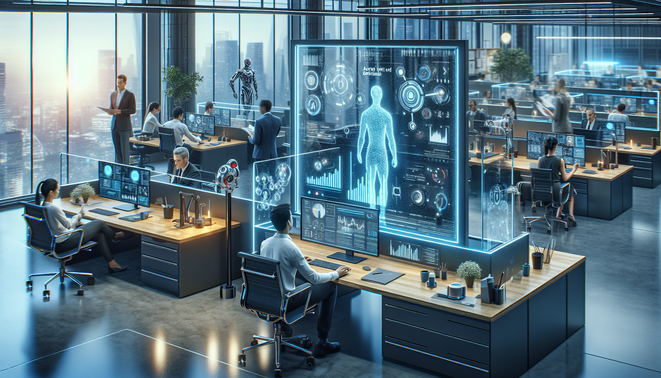
Picture this: A radiologist in Boston reviews 200 chest X-rays in a morning with AI flagging anomalies, a feat that would have taken two full days a decade ago. Meanwhile, in Ohio, a data entry clerk receives notice that her position is being eliminated. And in San Francisco, a newly minted “prompt engineer” celebrates a $250,000 job offer—for a role that didn’t exist three years ago.
These aren’t hypothetical scenarios. They’re snapshots of a workforce transformation unfolding right now, as artificial intelligence reshapes the employment landscape faster than any technological shift in modern history. Yet here’s the paradox: while headlines scream about AI stealing jobs, companies are desperately hunting for workers with the right skills to thrive in this new era. The future of work isn’t about humans versus machines—it’s about understanding which remix of human and artificial intelligence will define the careers of tomorrow.
The Intelligence Augmentation Revolution
We’re past the point of asking whether AI will transform work. It already is. Today’s enterprise AI systems can draft legal briefs, debug complex code, diagnose diseases from medical imaging, and predict equipment failures before they happen. The technology has evolved from simple automation—robots on assembly lines—to cognitive augmentation that enhances how we think and decide.
The impact varies dramatically by industry. Software development is experiencing what one industry analyst called “the biggest productivity leap since the compiler.” Developers using AI coding assistants are writing code up to three times faster, though the technology works more like an intelligent autocomplete than a replacement programmer. Financial services firms are deploying AI systems that can analyze thousands of contracts in hours, work that previously required armies of junior analysts working for weeks.
Healthcare presents perhaps the most compelling transformation story. AI diagnostic tools now match or exceed human accuracy in detecting certain cancers, diabetic retinopathy, and cardiac abnormalities. But here’s what’s fascinating: rather than replacing radiologists, these tools are allowing them to focus on complex cases that require nuanced clinical judgment while the AI handles routine screening.
The numbers tell a striking story. Recent economic analysis suggests AI could add between $2.6 and $4.4 trillion to the global economy annually. Data centers—the physical infrastructure powering this revolution—are projected to require over one trillion dollars in investment by 2030. This infrastructure boom alone is creating thousands of specialized roles from cooling systems engineers to AI infrastructure architects.
The Job Market’s Identity Crisis
If you’re feeling anxious about these changes, you’re not alone. But the reality is more nuanced than the doom-and-gloom headlines suggest. Yes, automation is coming for certain roles. Data entry clerks, telemarketers, and routine bookkeepers face the highest displacement risk. Yet simultaneously, entirely new career categories are emerging at a pace that’s making HR departments scramble.
Consider the role of “prompt engineer”—someone who optimizes how humans interact with AI systems. Demand for these specialists has surged 300 percent in the past two years, with salaries ranging from $150,000 to $335,000. AI ethics officers, a position virtually nonexistent five years ago, are now being recruited by major corporations desperate to navigate the complex moral terrain of algorithmic decision-making.
The augmentation versus automation debate reveals the real story. A Stanford economist captured it perfectly: “History shows technology creates more jobs than it destroys, but not necessarily for the same people or in the same places.” The challenge isn’t whether new jobs emerge—they always do—but whether displaced workers can access them.
Take customer service, an industry employing millions. AI chatbots now handle 60 to 70 percent of routine inquiries, and yes, entry-level call center positions are disappearing. But the flip side? Companies are desperately hiring for complex problem-solving roles that require empathy, judgment, and the ability to handle situations AI can’t navigate. These positions pay better than the ones being automated, but they require different skills.
The job market reconfiguration breaks down roughly into thirds. About one-third of current roles face high displacement risk—primarily routine cognitive and manual tasks. Another third will be significantly transformed, with AI handling components while humans focus on higher-value activities. The final third—roles requiring creativity, emotional intelligence, complex judgment, or physical dexterity in unpredictable environments—remain relatively insulated, at least for now.
What’s particularly noteworthy is the geographic dimension. AI jobs are concentrating in major metropolitan areas, while job displacement hits hardest in regions dependent on routine manufacturing and administrative work. As one policy researcher bluntly noted, workers without college degrees face three times higher displacement risk. This isn’t just an economic challenge; it’s becoming a political one.
The New Career Essentials
So what does it take to thrive in this remixed workforce? The answer combines technical fluency with distinctly human capabilities—what some are calling “hybrid intelligence.”
On the technical side, you don’t necessarily need to become a machine learning engineer (though demand for those roles remains intense). But AI literacy is rapidly becoming as essential as computer literacy was in the 1990s. Understanding how AI systems work, their limitations, and how to evaluate their outputs is becoming table stakes across industries. Professionals who can bridge domain expertise with AI capabilities—think lawyers who understand legal tech, or doctors who can leverage diagnostic AI—command premium value.
Prompt engineering represents a new frontier. It sounds simple—crafting effective instructions for AI systems—but done well, it’s a sophisticated skill combining technical understanding, clear communication, and domain knowledge. As one AI researcher noted, “AI literacy will be essential for 21st-century workers across all industries,” much like basic literacy defined workforce viability in the last century.
But here’s where it gets interesting: the most valuable skills aren’t technical at all. As AI handles more analytical tasks, uniquely human capabilities are appreciating in value. Emotional intelligence—understanding and navigating complex human dynamics—can’t be automated. Strategic thinking that reframes problems rather than just solving them remains human territory. Creativity that generates truly novel ideas, rather than recombining patterns, stays in our domain.
Organizations are hunting for what they call “human-AI collaboration managers”—people who can orchestrate workflows combining human judgment and machine efficiency. Change management expertise is exploding in value as companies struggle to integrate AI without destroying morale. The ability to ask the right questions, to know what problems are worth solving, to understand context and nuance—these cognitive capabilities that seem effortless to humans remain remarkably difficult for AI.
The educational pathway looks increasingly diverse. Traditional four-year degrees are adding mandatory AI coursework, but alternative credentials are gaining ground. Three- to six-month bootcamps, online certificates, and micro-credentials offer faster on-ramps to in-demand skills. Major companies are building internal reskilling programs rather than waiting for the education system to catch up.
The catch? Access remains uneven. Sixty percent of employers report difficulty finding workers with needed AI skills, yet only 35 percent of workers have access to adequate reskilling opportunities. Geography, cost, and time constraints create barriers that policy hasn’t adequately addressed.
Navigating the Transition
The honest truth is we’re in uncertain territory. Will AI capabilities plateau or continue exponential improvement? Will job creation match displacement in speed and accessibility? Can education systems reskill workers fast enough? These questions lack definitive answers.
What’s clear is that managing this transition requires action from multiple stakeholders. Workers need to adopt a lifelong learning mindset—the days of learning a skill set once and coasting for 40 years are over. Investing in hybrid skills that combine technical fluency with human capabilities offers the best hedge against displacement.
Companies bear responsibility for investing in workforce transitions rather than simply swapping humans for algorithms. The most successful organizations are treating AI as augmentation technology, redesigning workflows to leverage both human and artificial intelligence optimally.
Policymakers face perhaps the biggest challenge: creating support systems for a workforce in flux. This means not just unemployment benefits but portable benefits, accessible reskilling programs, and incentives for companies to invest in workers rather than just efficiency.
The workforce remix is happening whether we’re ready or not. But unlike previous technological disruptions, this one is unfolding with unusual speed. Microsoft’s CEO got it right: “The most successful workers will be those who learn to effectively collaborate with AI systems while maintaining uniquely human capabilities.” That collaboration—that remix of human and artificial intelligence—is where the future of work lives.
The question isn’t whether your job will be affected by AI. It will be. The question is whether you’ll be positioned to benefit from the transformation or be left scrambling to catch up. The great workforce remix has begun, and the next verse is yours to write.