The AI Job Revolution: Your Career in the Age of Intelligence
Picture this: It’s 2024, and semiconductor companies are turning away orders worth billions of dollars. Not because they want to, but because they simply cannot manufacture AI chips fast enough to meet demand. Lead times stretch nearly a year. Tech giants are collectively pouring over $200 billion into AI infrastructure. And somewhere in this frenzy, your job—whatever it is—is being quietly reimagined.
We’re witnessing something unprecedented. The AI boom isn’t just another tech trend; it’s a fundamental restructuring of how work gets done. From Wall Street trading floors to hospital radiology departments, from marketing agencies to factory floors, intelligent systems are changing not just what we do, but how we think about human contribution to the economy. The question isn’t whether AI will transform your industry—it’s whether you’ll be ready when it does.
This isn’t a story about robots stealing jobs. It’s more nuanced, more interesting, and ultimately more hopeful than that. It’s about the largest workforce transformation in a generation, and why the winners won’t be those who resist change, but those who learn to dance with it.
The Transformation Already Underway
The numbers tell a dramatic story. Data center construction spending has surged 40% year-over-year, driven almost entirely by AI workloads. Nvidia’s data center revenue alone exceeded $47 billion in recent quarters—a figure that would have seemed fantastical just three years ago. Training a single cutting-edge AI model now costs over $100 million, and companies are lining up to do it anyway.
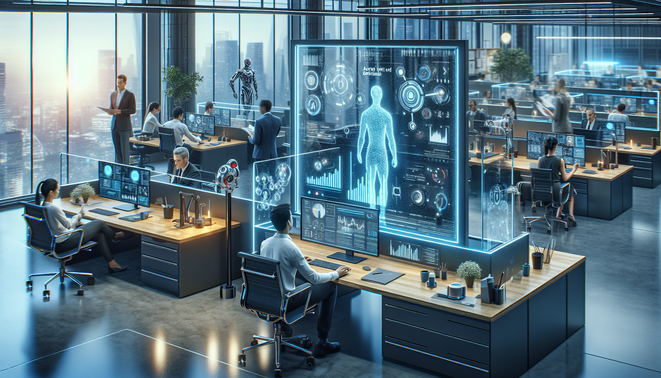
But the real transformation is happening in how these systems are being deployed. In financial services, AI now handles initial fraud detection, risk analysis, and even trading strategies that once occupied entire teams of analysts. Healthcare systems use AI to read preliminary scans, flagging anomalies for human radiologists to examine. Customer service operations that once employed hundreds now use conversational AI to handle routine inquiries, with humans stepping in for complex situations requiring empathy and judgment.
The creative industries are experiencing perhaps the most visible disruption. Marketing teams that once spent weeks on content variations now generate hundreds of options in hours. Designers use AI to explore possibilities they’d never have time to sketch manually. Even software developers—the creators of these very tools—are seeing their workflows transformed, with AI coding assistants boosting productivity by up to 50%.
What’s striking isn’t just that AI can do these things, but how quickly adoption is accelerating. Roughly 85% of companies now plan to implement AI technologies by 2025. We’ve moved from “if” to “how fast” in the span of about eighteen months. The semiconductor analyst Stacy Rasgon captured the moment perfectly when observing the chip shortage: we’ve never seen this kind of demand trajectory in the industry’s history.
The Job Market Reconfiguration
Here’s where the conversation gets interesting—and where simplified narratives about “AI taking our jobs” fall apart under scrutiny. The reality is simultaneously more threatening and more promising than the headlines suggest.
Yes, displacement is real. Data entry clerks, telemarketers, basic bookkeeping roles, and routine customer service positions face automation risks between 60% and 90% over the next five to seven years. Junior programmers who only write code without understanding systems may find their skills commoditized. Travel agents, bank tellers, and proofreaders are seeing significant portions of their traditional work automated.
But here’s what the displacement narrative misses: we’re also seeing explosive job creation in entirely new categories. Prompt engineers—specialists who know how to communicate effectively with AI systems—command salaries between $175,000 and $350,000. AI ethics officers are becoming as essential as financial auditors. Companies are desperately hiring for roles that didn’t exist three years ago: synthetic data engineers, MLOps specialists, human-AI interaction designers, AI systems auditors.
Data center technician positions have grown 34% year-over-year. Demand for AI and machine learning engineers has increased over 300%. The World Economic Forum estimates that 97 million new roles may emerge by 2027 specifically adapted to AI-human collaboration. As one industry analyst noted succinctly, AI won’t replace workers, but workers using AI will replace those who don’t.
Perhaps most significantly, we’re seeing widespread job transformation rather than simple replacement. The radiologist’s role is evolving, not disappearing—AI handles the initial scan, but human expertise remains essential for complex cases, patient communication, and treatment planning. Financial analysts spend less time gathering data and more time on strategic interpretation. Lawyers use AI for document review but remain indispensable for strategy and negotiation. Marketing professionals let AI handle personalization at scale while they focus on brand strategy and creative direction.
MIT economist Daron Acemoglu offers a more cautious perspective, warning that short-term displacement may be understated and suggesting productivity gains might be more modest than tech industry projections. Yet even skeptics acknowledge the historical pattern: general-purpose technologies like electricity and the internet ultimately created more opportunities than they destroyed, even if transitions proved painful.
The augmentation versus automation debate misses the point. Both are happening. The question is which will dominate in your particular role and industry—and whether you’re positioned to benefit.
Skills for the AI Era
If you’re wondering what to learn next, you’re asking the right question. The skills landscape is being redrawn, and the winners will be those who understand which abilities AI complements versus which it replaces.
On the technical side, basic AI literacy is becoming as fundamental as computer literacy was in the 1990s. You don’t need a PhD in machine learning, but understanding how these systems work, their capabilities and limitations, and how to use them effectively will separate thriving professionals from struggling ones. Python programming, data analysis fundamentals, and familiarity with major AI tools—ChatGPT, GitHub Copilot, Midjourney—are rapidly moving from “nice to have” to baseline expectations across knowledge work.
For those going deeper, machine learning and cloud computing expertise remain in severe shortage. Seventy percent of companies report difficulty finding AI talent, driving salaries well into six figures even for mid-level positions. Universities are expanding AI programs by 150%, but demand still vastly outpaces supply.
Yet here’s the counterintuitive insight: as AI handles more cognitive routine work, distinctly human skills become more valuable, not less. Critical thinking—knowing what questions to ask AI and how to evaluate its outputs—becomes paramount. Emotional intelligence and empathy are impossible to automate and increasingly differentiate premium services from commodity ones. Creativity and innovation, the ability to generate genuinely novel approaches, remain firmly in human territory.
Ethical judgment matters more, not less, in an AI-augmented world. Someone needs to make values-based decisions about when and how to deploy these powerful tools. Communication and collaboration, especially the human-to-human kind, become differentiators in a world where AI handles routine information transfer. And perhaps most critically, adaptability and continuous learning—what educators call “learning agility”—may be the metaskill that matters most.
Stanford’s Human-Centered AI Institute frames it perfectly: the future workforce needs to be “AI-plus”—humans who leverage AI tools while bringing uniquely human capabilities to the table. Educational pathways are evolving to match. Micro-credentials and certificates offer rapid AI skills training. Universities are adding AI minors across disciplines. Interdisciplinary degrees combining AI with domain expertise—AI plus healthcare, AI plus law, AI plus design—are proliferating.
The World Economic Forum estimates that 50% of employees will need reskilling by 2027, with an average of 44% of worker skills disrupted. The uncomfortable truth is that one-time education won’t cut it. Continuous learning isn’t an optional extra anymore; it’s the core competency.
The Path Forward
So where does this leave us? Neither in dystopia nor utopia, but somewhere more complex and more human.
The AI transformation will create winners and losers. Some workers will find themselves displaced without adequate support for transition. Some companies will capture enormous value while others struggle to adapt. Some communities will thrive while others face painful disruption. Pretending otherwise serves no one.
But the trajectory isn’t predetermined. For individuals, the path forward means embracing both technical and human skills development. It means viewing AI as a collaborator rather than a competitor. It means cultivating learning agility and staying curious about emerging tools and techniques. And it means focusing on work that requires judgment, creativity, emotional intelligence, and ethical reasoning—the things that make us irreplaceably human.
For employers, it means investing in workforce development with the same enthusiasm currently directed toward AI infrastructure. It means reimagining roles around human-AI collaboration rather than simple replacement. And it means recognizing that the most successful organizations will be those that figure out how to amplify human potential through technology rather than simply substituting machines for people.
For policymakers and educators, the imperative is clear: massive reskilling programs, educational systems redesigned for continuous learning, and social support structures for workers in transition. The market alone won’t solve this fast enough or fairly enough.
The AI revolution is here. The demand surge semiconductor analysts are tracking represents just the infrastructure layer of a much broader transformation. Your job—whatever it is—will likely look quite different in five years. That’s not a threat. It’s an invitation to evolve, to learn, to focus on what makes your contribution uniquely human. The future belongs not to those who compete with AI, but to those who learn to make AI compete for them.