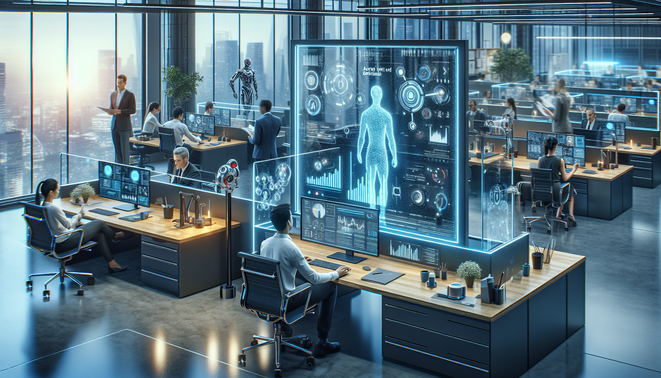
Picture this: A marketing manager creates a month’s worth of social media content in an afternoon. A financial analyst processes quarterly reports that once took a week in under an hour. A radiologist reviews twice as many scans with greater accuracy than ever before. This isn’t science fiction—it’s Tuesday.
We’re living through one of the most profound workforce transformations in human history, yet the conversation remains stuck in a false binary: Will AI take our jobs or not? The real question is far more nuanced and interesting. How will artificial intelligence reshape what work means, who does it, and what skills make us indispensable?
The answer matters because according to recent economic research, we’re not just witnessing incremental change. We’re experiencing a complete reconfiguration of work itself, one that will demand career pivots for millions while creating opportunities that didn’t exist five years ago.
The Transformation Already Underway
Today’s AI systems have crossed a threshold. Unlike the narrow automation tools of the past decade, generative AI platforms can now write code, design marketing campaigns, draft legal documents, diagnose medical conditions, and even engage in creative work. This isn’t about robots on assembly lines anymore—this is about artificial intelligence entering the domain of knowledge work and professional services.
The numbers tell a striking story. Recent analysis suggests that generative AI could automate work activities consuming up to 70% of employee time across various sectors. In practical terms, this means activities accounting for roughly 30% of current work hours could be automated within the next six years. We’re talking about 12 million occupational transitions in the United States alone.
But here’s what makes this different from previous automation waves: AI isn’t just replacing tasks—it’s augmenting human capability in unexpected ways. A Harvard Business School study found that marketing professionals using AI tools showed a 40% productivity increase, while lower-performing workers improved their output quality by 43%. The technology isn’t just making work faster; it’s democratizing expertise.
The industries feeling this shift first include professional services, where AI now handles contract review and legal research; healthcare, where diagnostic imaging gets AI-powered pattern recognition; and creative fields, where content generation has become instantaneous. Financial services are deploying robo-advisors and algorithmic trading systems. Even education is transforming as personalized AI tutors reshape how students learn.
The Great Job Market Reconfiguration
So what happens to employment in this new landscape? The reality is more complex than doom-and-gloom predictions suggest. The World Economic Forum projects that while 83 million jobs may be eliminated over the next five years, 69 million new ones will be created. The net effect? Transformation, not devastation—but transformation that will feel deeply disruptive to millions of workers.
Jobs at highest risk share common characteristics: they’re routine, predictable, and rule-based. Data entry clerks face 90% automation potential. Telemarketers and basic bookkeepers aren’t far behind. Customer service representatives handling routine inquiries will find their roles fundamentally reimagined, with AI chatbots already managing 60-80% of standard customer interactions.
Yet the more interesting story lies in job transformation rather than elimination. Consider software developers, who now work alongside AI coding assistants that can generate functional code from plain English descriptions. These developers haven’t become obsolete—they’ve evolved into architects and strategic problem-solvers, freed from routine coding to focus on complex system design.
Financial advisors offer another compelling example. AI can now handle portfolio analysis and routine investment recommendations with impressive sophistication. Rather than disappearing, successful advisors are pivoting toward relationship-building, complex life planning, and providing the emotional intelligence that algorithms cannot replicate. As one economist noted, “AI is democratizing expertise while raising the ceiling for expert performance.”
The same pattern emerges across professions. Designers use AI for rapid prototyping but focus their human creativity on strategic direction. Writers employ AI drafting tools but concentrate on voice, authenticity, and editorial judgment. Doctors receive AI-assisted diagnostics but invest their expertise in patient relationships and treatment of complex cases.
Meanwhile, entirely new job categories are exploding into existence. AI and machine learning specialists top the list of fastest-growing roles, with projected demand for 1-2 million such positions globally by 2030. But the opportunities extend far beyond technical roles. AI ethics officers, algorithmic bias auditors, prompt engineers, and AI literacy trainers represent emerging professions that didn’t exist five years ago. Stanford’s latest research reveals that AI job postings have increased 3.5 times between 2021 and 2023, with median AI researcher salaries exceeding $300,000 in tech companies.
Skills That Will Define Career Success
If the nature of work is changing this dramatically, what skills will matter most? The answer combines technical fluency with distinctively human capabilities—a hybrid approach that leverages AI while doing what algorithms cannot.
Start with AI literacy, which is rapidly becoming as fundamental as computer literacy was in the 1990s. Every professional needs to understand AI capabilities and limitations, craft effective prompts, and evaluate AI-generated outputs critically. This isn’t about becoming a data scientist; it’s about developing competence in collaborating with AI systems. Companies are recognizing this urgency—corporate investment in AI training programs has surged 170% year-over-year.
But technical skills tell only half the story. The capabilities that make us irreplaceable are distinctly human. Complex problem-solving in novel situations remains an area where AI struggles. Machines excel at pattern recognition in familiar contexts but falter when confronted with unprecedented challenges requiring adaptive, creative thinking.
Emotional intelligence has evolved from a nice-to-have soft skill to a critical competitive advantage. As AI handles more transactional interactions, the premium on genuine human connection intensifies. Empathy, relationship building, conflict resolution, and reading emotional nuances—these capabilities create value that no algorithm can provide.
Critical thinking and judgment matter more than ever precisely because we’re surrounded by AI-generated content and recommendations. Someone needs to evaluate those recommendations, understand context, make ethical decisions, and exercise strategic judgment. As researchers emphasize, “the winners will be determined by policy choices we make,” requiring human wisdom at every level.
The most valuable professionals will master what we might call hybrid AI-human skills: knowing when to use AI versus human judgment, delegating effectively to AI systems, and combining algorithmic insights with human intuition. Job postings mentioning AI collaboration skills have increased 400%, signaling that employers are actively seeking people who can bridge the human-machine divide.
The Path Forward
Where does this leave us? The transformation underway is neither utopian nor apocalyptic—it’s profoundly human. We’re not facing job extinction but rather the most significant workforce transition in generations, one that will create winners and losers depending largely on how we choose to respond.
For individual workers, the imperative is clear: embrace continuous learning. The World Economic Forum estimates that 60% of workers will require training by 2027, with 44% of current skills becoming disrupted. Building learning agility—the ability to acquire new skills rapidly and pivot when necessary—may be the single most valuable capability in an AI-driven economy.
For employers, the challenge is moving beyond viewing AI as a cost-cutting tool and instead investing in human-AI collaboration. Companies that help their workforce develop AI literacy while cultivating uniquely human skills will outperform those focused solely on automation for efficiency.
For policymakers and educational institutions, the moment demands urgent action to create pathways for the millions who will need to transition between roles. Lifelong learning infrastructure, accessible reskilling programs, and social safety nets for those caught in transition aren’t optional—they’re essential to ensuring this transformation creates broadly shared prosperity rather than deepening inequality.
The future belongs not to AI, nor to humans resistant to technological change, but to humans who learn to work alongside AI effectively. The jobs of the future will require us to be more human, not less—more creative, more empathetic, more adaptable, and more strategic. That’s not a threat. That’s an invitation to become the best version of our professional selves.