The AI Work Revolution: What Your Job Will Look Like in 2030
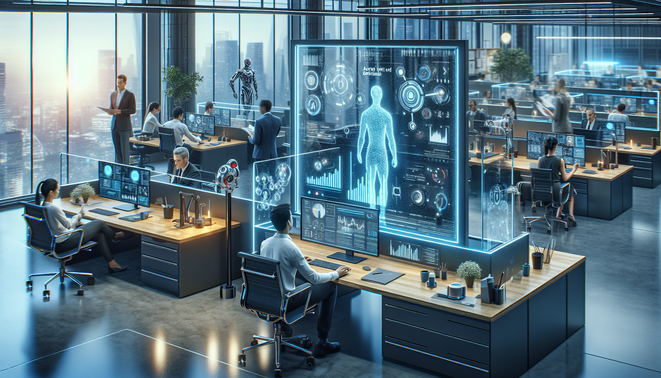
Imagine walking into your office in 2030. Your AI assistant has already prioritized your meetings, drafted three client proposals, analyzed competitor strategies, and flagged the two decisions that actually need your judgment. This isn’t science fiction—it’s the logical endpoint of a transformation already underway. Right now, as consolidated AI platforms make sophisticated tools accessible to every knowledge worker, we’re witnessing the most significant reconfiguration of professional work since the personal computer revolution.
The numbers tell a remarkable story: generative AI could add between $2.6 and $4.4 trillion to the global economy annually, with 60-70% of current work activities potentially automated or augmented. Yet here’s the paradox—while 83 million jobs may be displaced over the next five years, 69 million new ones are expected to emerge. The question isn’t whether AI will change your job, but how you’ll adapt to the version of work that’s coming.
The Quiet Revolution in Enterprise AI
Something fundamental has shifted in the past eighteen months. AI has moved from experimental novelty to production infrastructure. Companies aren’t asking whether to adopt AI—they’re racing to integrate it before competitors do. Enterprise spending on AI productivity tools jumped 187% between 2023 and 2024, and the pattern is unmistakable: every major software category now features an AI copilot.
What’s driving this surge? Platforms that consolidate multiple AI capabilities into unified workspaces have solved what industry insiders call “the fragmentation problem.” Instead of juggling ten different AI tools, workers now access diverse AI models and functions through single interfaces. This consolidation mirrors an earlier shift—remember when we moved from dozens of specialized desktop applications to integrated cloud suites?
The technology sector leads adoption at 62%, but the real surprise is how quickly traditional industries are following. Professional services firms report 45% adoption rates, while finance sits at 38%. Even healthcare, typically slow to embrace new technology, has reached 29% adoption. Small and medium businesses are actually moving faster than enterprises, unburdened by legacy systems and complex change management processes.
Consider what AI systems can do today: they match or exceed human performance on 75% of benchmarked tasks that previously required college-level expertise. Document review that took junior lawyers 20 hours now takes 45 minutes with AI supervision. Software developers using AI assistants complete projects 25% faster while producing 40% higher quality code. Marketing teams generate months of content variations in hours.
The Great Reshuffling: How Jobs Are Actually Changing
Here’s where the conversation gets nuanced—and where most media coverage gets it wrong. The jobs being displaced rarely disappear entirely; they transform, often dramatically. A MIT economist captured this well: “AI will eliminate tasks, not jobs, and create entirely new categories of work we can’t yet imagine.”
Take administrative assistants. The role isn’t vanishing—it’s evolving into something closer to “executive AI coordinator.” These professionals now manage AI assistants handling routine tasks while focusing on complex coordination requiring human judgment and relationship skills. They’ve moved up the value chain, not out of employment.
Similarly, junior lawyers are becoming legal AI supervisors, overseeing algorithmic document analysis rather than performing it manually. Customer service representatives are transforming into customer experience specialists who handle emotionally complex situations that AI can’t navigate. Entry-level developers are becoming code architects who design systems and review AI-generated code rather than writing every function from scratch.
The pattern repeats across industries: AI absorbs routine cognitive tasks while humans focus on judgment, creativity, strategy, and relationship management. As one consulting firm partner noted, “Our pyramid model is collapsing. We need fewer juniors doing rote work and more mid-level strategists.”
But let’s be direct about the disruption. Certain roles face genuine displacement risk. Data entry clerks, basic technical support, routine bookkeeping, proofreading, and paralegal document review are contracting significantly. The World Economic Forum projects 23% of all jobs will change substantially within five years, with clerical and secretarial positions declining fastest.
The flip side? Entirely new job categories are emerging. Prompt engineers—specialists in crafting effective AI instructions—command salaries between $80,000 and $175,000. AI ethics officers ensure responsible deployment. AI integration architects design systems connecting artificial intelligence with existing infrastructure. Human-AI workflow designers optimize how tasks divide between human and machine intelligence. These roles didn’t exist three years ago; now they’re among the fastest-growing positions.
The mathematical reality offers cold comfort: a net positive of 14 million jobs globally, but significant pain for individuals in displaced roles. As one Oxford economist cautioned, “The transition period will be painful. Unlike previous technological shifts that took decades, AI is being deployed at unprecedented speed.”
The New Professional Toolkit: Skills That Matter
If you’re wondering how to remain valuable in an AI-augmented workplace, the answer splits into three categories: AI-interaction skills, irreplaceably human competencies, and adaptive mindsets.
AI literacy is becoming as fundamental as email proficiency was in the 2000s. This means understanding prompt engineering—how to instruct AI systems effectively. It means recognizing AI limitations and hallucinations. It means knowing which tool fits which task and how AI integrates into broader workflows. Stanford’s Human-Centered AI lab frames it perfectly: “The skills gap isn’t just technical—it’s about judgment, ethics, and understanding AI limitations.”
Paradoxically, as AI handles more cognitive routine work, distinctly human capabilities command a growing premium. Complex problem formulation—asking the right questions rather than just getting answers—becomes critical when AI can answer almost anything you ask. Emotional intelligence, creative synthesis, ethical judgment in ambiguous situations, and strategic long-term thinking are skills AI struggles to replicate.
Harvard Business Review research found that workers using generative AI completed tasks 25% faster with 40% higher quality—but only when they’d developed strong AI collaboration skills. The headline from their study says it all: “Humans with AI will replace humans without AI.”
Then there’s the technical-adjacent layer. You don’t need to become a data scientist, but understanding data quality, interpretation, and limitations matters. Basic coding concepts help even non-developers understand algorithmic logic. Cybersecurity awareness is essential when AI systems access sensitive information. These aren’t deep technical skills—they’re literacy requirements for professional work.
Perhaps most importantly, the future belongs to continuous learners. The half-life of technical skills has dropped to just 2-3 years. Microsoft’s CEO put it bluntly when discussing workplace AI deployment: “Companies are making a critical error: deploying AI tools without investing in people’s ability to use them effectively.”
Educational models are adapting. Micro-credentials and skill-stacking approaches let professionals add targeted AI competencies to domain expertise. Universities are launching “AI plus X” programs—AI plus business, AI plus healthcare, AI plus creative arts. Companies are building internal AI academies. The credential isn’t the degree anymore; it’s your learning velocity.
Charting the Path Forward
So where does this leave us? Standing at an inflection point with genuine cause for both optimism and concern.
The optimistic case is compelling: AI handling cognitive drudgery frees humans for creative and strategic work. Productivity gains could drive economic growth that creates abundant new opportunities. Workers who master AI collaboration tools report higher job satisfaction, not lower—they’re freed from tedious tasks to focus on meaningful work. As AI pioneer Andrew Ng argues, “We’re not heading toward human-AI competition but human-AI collaboration.”
The challenging reality is equally clear: transition periods are painful, and this one is moving faster than previous technological shifts. Workers in at-risk roles need support—not platitudes about how it’ll work out eventually. Educational systems must transform from front-loaded degree programs to lifelong learning ecosystems. Companies must invest in training, not just technology. Policymakers need updated social contracts around work, benefits, and economic security.
For individuals: start experimenting with AI tools in your domain now. Identify which of your tasks AI could augment and develop workflows that combine your judgment with machine efficiency. Invest in skills that make you a better AI collaborator and in distinctly human capabilities that AI can’t replicate. Most importantly, embrace continuous learning as a permanent professional state.
For organizations: deploy AI and training together, not sequentially. Design workflows around human-AI collaboration rather than simple automation. Create cultures that reward experimentation and learning.
For educators: build programs that stack AI literacy onto domain expertise. Teach critical thinking about AI outputs, not just AI usage.
The future of work isn’t humans versus AI—it’s humans with AI versus humans without it. The question isn’t whether your job will change, but whether you’ll lead that change or be swept along by it. The tools are here. The transformation is underway. Your move.